Lemma 6.3.23. Let \(C\) be a stable \(\infty \)-category equipped with a t-structure. For \(n,m \in \Z \), the canonical natural transformation \[ \tau _{\leq m} \tau _{\geq n} \to \tau _{\geq n} \tau _{\leq m} \] is a natural isomorphism of functors \(C \to C_{\leq m} \cap C_{\geq n}\).
Proof. By Lemma 6.3.10, both composites take values in \(C_{\leq m} \cap C_{\geq n}\). If \(n>m\), this intersection is zero by orthogonality, so both composites are zero. We may therefore assume that \(n \leq m\).
Fixing \(Y \in C\), the map \(\tau _{\geq n} Y \to Y\) induces \(\tau _{\leq m} \tau _{\geq n} Y \to \tau _{\leq m} Y\). Since the source is \(n\)-connective, this factors uniquely through a map \[ \tau _{\leq m} \tau _{\geq n} Y \to \tau _{\geq n} \tau _{\leq m} Y, \] which is the ‘canonical map’ from the statement. To show it is an isomorphism, we may equivalently show that the cofiber of \(\tau _{\leq m} \tau _{\geq n} Y \to \tau _{\leq m} Y\) is \((n-1)\)-coconnective. To this end, we may compare the truncation sequences for \(\tau _{\geq n} Y\) and \(Y\) to obtain a commutative diagram
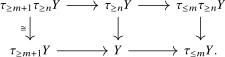
Since \(m \geq n\), the left vertical map is an isomorphism. By the pasting law for exact squares, it follows that the cofiber of the right vertical map is the cofiber of the middle vertical map. This cofiber is \(\tau _{\leq n-1}Y\), which is \((n-1)\)-coconnective, finishing the proof. □