Theorem 7.3.15 (The \(p\)-adic arithmetic fracture square). Let \(X\) be a spectrum. Then the following commutative square is a pullback square:
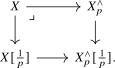
Proof. We have to show that the map \(X \to X[\frac {1}{p}] \times _{X^{\wedge }_p[\frac {1}{p}]} X^{\wedge }_p\) is an isomorphism, or equivalently that its fiber \(F\) is the zero spectrum. Note that \(F[\frac {1}{p}] = 0\), since the square
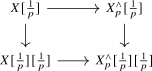
is a pullback square (as the two vertical maps are isomorphisms). We claim that also \(F/p = 0\), so that \(F = 0\) by Lemma 7.3.14, applied with \(P=\{p\}\). To see this, we need to show that the commutative square
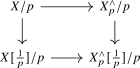
is a pullback square. The two objects at the bottom are zero, since the maps \(p\colon X[\frac {1}{p}] \to X[\frac {1}{p}]\) and \(p\colon X^{\wedge }_p[\frac {1}{p}] \to X^{\wedge }_p[\frac {1}{p}]\) are isomorphisms by Corollary 7.2.5. In particular the bottom map is an isomorphism. But the top map is also an isomorphism, since the map \(X \to X^{\wedge }_p\) is by definition an \(\S /p\)-equivalence. This finishes the proof. □