Proposition 2.4.26 (Puppe sequence). Given a fiber sequence \(F \xrightarrow {i} E \xrightarrow {p} B\) in \(\An _*\), there is a sequence \[ \dots \xrightarrow {\Omega ^2 p} \Omega ^2 B \xrightarrow {-\Omega \delta } \Omega F \xrightarrow {-\Omega i} \Omega E \xrightarrow {-\Omega p} \Omega B \xrightarrow {\delta } F \xrightarrow {i} E \xrightarrow {p} B, \] where each consecutive triple forms a fiber sequence.
Proof. To see that \(\Omega B\) is indeed the fiber of \(i\), consider the following commutative diagram:
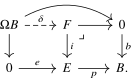
Here the outer square is the one defining \(\Omega B\), and the right square is obtained by flipping the given fiber sequence. The map \(\delta \) is induced by the universal property of the pullback \(F\), and it follows from the pasting law of pullback squares that also the left square is a pullback square, thus exhibiting \(\Omega B\) as the fiber of \(i\).
Next, we identify the fiber of \(\delta \). In the pullback description, an element of \(F\) consists of \(e\in E\) and an identification \(\beta \colon p(e)\simeq b_0\), and \(\delta \) sends a loop \(\lambda \) to \((e_0,\lambda )\). An identification from \((e_0,\lambda )\) to the basepoint \((e_0,\id )\) consists of a loop \(\alpha \) in \(E\) together with an identification \(\lambda \simeq p(\alpha )\). Using \(\alpha ^{-1}\) as the coordinate on this fiber therefore identifies its map to \(\Omega B\) with \(-\Omega p\). This gives the following pullback diagram:
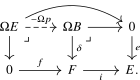
Looping these three fiber squares and using the natural inversion maps gives all remaining triples with the displayed signs. □