Example 24.1.10. Let \(C\) be an \(\infty \)-category, let \(E := \Ar (C)\) be its arrow category, and consider the target functor \(p := t\colon \Ar (C) \to C\). An object of \(E\) is given by a morphism in \(C\), which for emphasis we will write vertically: \(\smash {\pvto {X}{Y}}\). A morphism \(\phi \colon \smash {\pvto {X}{Y}} \to \smash {\pvto {X'}{Y'}}\) in \(E\) is given by a commutative square in \(C\) of the form

We claim:
- (1)
-
The morphism \(\phi \) in \(E\) is \(p\)-cocartesian if and only if \(g\) is an isomorphism. In particular, \(t\) is always a cocartesian fibration: given \(e = \pvto {X}{Y}\) and \(f \colon p(\pvto {X}{Y}) = Y \to Y'\) we may always form the square with \(X' := X\) and \(g = \id _X\).
- (2)
-
The morphism \(\phi \) in \(E\) is \(p\)-cartesian if and only if the square is a pullback square (a.k.a. a cartesian square). In particular, \(t\) is a cartesian fibration if and only if \(C\) admits pullbacks.
Indeed, claim (1) translates the defining universal property of a cocartesian morphism into the following lifting property: for every third object \(\smash {\pvto {X''}{Y''}}\) of \(E\) and every solid diagram below, there exists a unique dashed arrow making the diagram commute:
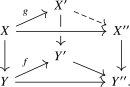
If \(g\) is an isomorphism, we may invert it and the dashed filler is unique. Conversely, if \(\phi \) is \(p\)-cocartesian, then by taking \(X'' = X\) we obtain a morphism \(g' \colon X' \to X\) satisfying \(g' g \cong \id _X\), and by taking \(X'' = X'\) we use uniqueness to obtain \(gg' \cong \id _{X'}\).
Similarly, claim (2) translates the defining universal property of a cartesian morphism into the existence of a unique dashed arrow in every solid diagram of the following form:
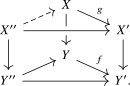
This is the universal property of the original square being a pullback square. Passing to opposite categories shows dually that the source functor \(s\colon \Ar (C)\to C\) is always a cartesian fibration, and that it is also a cocartesian fibration if and only if \(C\) admits pushouts.