Lemma A.24 (Conjugate transformations). Let \(F_1 \dashv G_1\) and \(F_2 \dashv G_2\) be adjunctions between categories \(A\) and \(B\), with
\(F_i\colon A \to B\). For every natural transformation \(\phi \colon F_1 \to F_2\) there is a unique natural transformation \(\phi ^{\vee }\colon G_2 \to G_1\), its conjugate, such that
the square 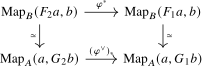 commutes naturally in \(a\) and \(b\). Moreover, \(\phi \) is an isomorphism if and only if \(\phi ^{\vee }\) is.
Proof.
The composite of the top map with the vertical isomorphisms is a natural transformation \(\Map _A(-,G_2(-)) \to \Map _A(-,G_1(-))\), which by the Yoneda lemma is induced by a unique natural transformation \(\phi ^{\vee }\colon G_2 \to G_1\). Again by the Yoneda lemma, \(\phi \) is an isomorphism if and only if \(\phi ^*\) is an isomorphism for all \(a,b\), if and only if \((\phi ^{\vee })_*\) is an isomorphism for all \(a,b\), if and only if \(\phi ^{\vee }\) is an isomorphism. □