Lemma A.22. Let \(g\colon C \to D\) be a retract of \(g'\colon C' \to D'\) in \(\Fun (\Delta ^1,\widehat {\Cat })\), where \(C,C',D,D'\) are locally small. Suppose that \(g'\) has a left adjoint \(f'\) and that \(C\) is idempotent complete. Then \(g\) has a left adjoint.
Proof.
Consider a retract diagram 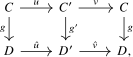 with \(vu \simeq \id _C\) and \(\hat {v}\hat {u} \simeq \id _D\), compatibly with the squares. By [Lurie (2009), Proposition 5.2.4.2], it suffices to show
that for every \(d \in D\) the functor \(F_d = \Map _D(d,g(-))\colon C \to \An \) is corepresentable. Since \(C\) is idempotent complete, it suffices to exhibit \(F_d\) as
a retract of the corepresentable functor \(\Map _C(x,-)\), where \(x = vf'\hat {u}(d)\). Denote by \(\eta \) the unit of the adjunction \(f' \dashv g'\) and by \(\phi \mapsto \phi ^{\flat }\) the
adjunction bijection \(\Map _{D'}(e,g'(c')) \simeq \Map _{C'}(f'(e),c')\). We define natural transformations \[ F_d \xrightarrow {\;i\;} \Map _C(x,-) \xrightarrow {\;p\;} F_d \] as follows. For \(c \in C\) and \(\phi \colon d \to g(c)\), let \(i(\phi )\) be the composite \[ x = vf'\hat {u}(d) \xrightarrow {v((\hat {u}\phi )^{\flat })} vu(c) \simeq c, \]
where \(\hat {u}\phi \colon \hat {u}(d) \to \hat {u}g(c) \simeq g'u(c)\). For \(\chi \colon x \to c\), let \(p(\chi )\) be the composite \[ d \simeq \hat {v}\hat {u}(d) \xrightarrow {\hat {v}(\eta _{\hat {u}d})} \hat {v}g'f'\hat {u}(d) \simeq gvf'\hat {u}(d) = g(x) \xrightarrow {g(\chi )} g(c). \] Both constructions are natural in \(c\). Using \(gv \simeq \hat {v}g'\) and the triangle identity
\(g'((\hat u \phi )^{\flat }) \circ \eta _{\hat {u}d} = \hat {u}\phi \), we compute \[ p(i(\phi )) = gv((\hat u\phi )^{\flat }) \circ \hat {v}(\eta _{\hat u d}) \simeq \hat {v}\big (g'((\hat u\phi )^{\flat })\circ \eta _{\hat u d}\big ) = \hat {v}\hat {u}(\phi ) \simeq \phi , \] so \(pi \simeq \id \). Hence \(F_d\) is a retract of \(\Map _C(x,-)\), as desired. □