This chapter introduces span categories, which provide the organizing language for the approach to higher algebra taken in this book. They offer a convenient way to encode algebraic structures in settings such as spectral Mackey functors [Barwick (2017)], normed \(\infty \)-categories [Bachmann and Hoyois (2021)], and six-functor formalisms [Scholze (2025); Heyer and Mann (2024)]. Their use in higher algebra is not yet standard, in part because Lurie’s foundational text [Lurie (2017)] takes a different approach, so we give a detailed development of their construction.
Let \(C\) be an \(\infty \)-category with pullbacks, and let \(C_L\) and \(C_R\) be collections of morphisms of \(C\) closed under composition and pullback. Then the span category \(\Span (C,C_L,C_R)\) associated with this triple is an \(\infty \)-category whose objects are the objects of \(C\), while the morphisms from \(X\) to \(Y\) are given by spans

where \(f \in C_L\) and \(g \in C_R\). The identity morphism is the identity span \(X \xleftarrow {\id _X} X \xrightarrow {\id _X} X\). The composition of a span \(X \leftarrow U \rightarrow Y\) with a span \(Y \leftarrow V \rightarrow Z\) is given by forming pullbacks:
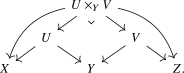
To turn this description into an \(\infty \)-category, we must account for the higher coherences of composition by pullbacks. We follow the construction of Barwick (2017) and Haugseng et al. (2023b).
Sections
Constructing span categories
Span categories of ∞-categories with pullbacks.
Adjunctions of span categories
Natural transformations and adjunctions induced on span categories.
Products and coproducts in span categories
Finite products and coproducts in span categories.