Theorem 11.3.10 (Atiyah duality). The map \(\ev \) exhibits \(\th (-T_M)\) as a dual of \(\S [M]\), and hence determines an isomorphism: \[ D(\S [M])\cong \th (-T_M). \]
Proof. Write \(a_N\colon S^N\to S^N\) for the one-point compactification of \(-\id _{\R ^N}\), of degree \((-1)^N\). With the symmetries in the definitions of \(\ev \) and \(\coev \), the triangle identities follow from the point-set homotopies \[ (\id \wedge \ev _0)\circ (\coev _0\wedge \id ) \simeq (\id _{\Th (\nu )}\wedge a_N)\circ \tau _{S^N,\Th (\nu )}, \] \[ (\ev _0\wedge \id )\circ (\id \wedge \coev _0) \simeq \tau _{M_+,S^N}. \] The sources are \(S^N\wedge \Th (\nu )\) and \(M_+\wedge S^N\), respectively. The symmetry interchanging \(\S [-N]\) and \(\S [N]\) acts by \((-1)^{-N^2}=(-1)^N\); compare Warning 4.2.11. In the first triangle this cancels the map induced by \(a_N\); the second triangle has no remaining sphere interchange. We verify the second identity by a graph isotopy, and the first by the same method together with a rotation of the two normal-bundle summands.
We start with the first composite. Consider the following pullback square:
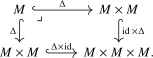
At \((m,m)\), the map induced by \(\Delta \times \id \) into the normal bundle of \(\id \times \Delta \) is \[ T_mM\oplus T_mM\longrightarrow T_mM,\qquad (v,w)\longmapsto w-v. \] It is surjective, proving transversality, and agrees with our normal-bundle convention for the diagonal. Apply transverse base change in Proposition 11.3.9 with twist \(\nu \times \ul 0\times \nu \).
For embeddings into \(S^N\times M\) or \(M\times S^N\), we choose tubular neighborhoods avoiding the fiber at infinity. Compactness permits this throughout the graph isotopies below, so the collapse maps descend to the reduced quotients. We use these reduced maps without further notation. Together with the definitions of \(\ev _0\) and \(\coev _0\), transverse base change gives the following homotopy-commutative diagram:
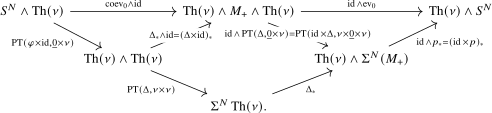
The top row is the first triangle composite. The upper two triangles commute by the definitions of \(\coev _0\) and \(\ev _0\), and the central diamond commutes by transverse base change. At the bottom vertex, the identification \(\Th (T_M\oplus \nu \oplus \nu )\cong S^N\wedge \Th (\nu )\) uses \((t,v,w)\mapsto (d\phi (t)+w,v)\); the outgoing pushforward places the \(\nu \)-factor first and records the point of \(M\) over which it lies. Compatibility with composition identifies the successive collapses with the twisted collapse for the graph embedding \[ j\colon M \xhookrightarrow {\Delta } M \times M \xhookrightarrow {\phi \times \id } S^N \times M, \] with twist \(\ul 0\times \nu \). To identify the whole composite, we must also track the bundle isomorphism used at the bottom vertex. For the isotopy \(j_s=(s\phi ,\id )\), identify the normal bundle with \(\ul {\R ^N}\) by \[ [(z,u)]\longmapsto z-s\,d\phi (u). \] At \(s=1\), write the normal coordinate as \(\eta =z-d\phi (u)=d\phi (t)+v\), with \(v\in \nu _m\). The convention \([(u_1,u_2)]\mapsto u_2-u_1\) for the diagonal sends the tangential component to \(-t\). Including the right diagonal maps, the triangle composite is therefore the graph collapse followed by the Thom map of \[ F\colon \ul {\R ^N}\oplus \nu \longrightarrow \nu \oplus \ul {\R ^N}, \qquad (d\phi (t)+v,w)\longmapsto (v,-d\phi (t)+w). \] Transport this identification along \(j_s\). At \(s=0\), the collapse for the zero graph is homotopic to the identity on \(S^N\wedge \Th (\nu )\) before applying the Thom map of \(F\). The base map in the right diagonal is \((\id \times p)\circ \Delta =\id _M\), so no further base map remains.
The bundle isomorphisms \[ (d\phi (t)+v,w)\longmapsto \bigl (\cos \theta \,v+\sin \theta \,w,\, -d\phi (t)-\sin \theta \,v+\cos \theta \,w\bigr ), \qquad 0\leq \theta \leq \pi /2, \] join \(F\) to \((\eta ,w)\mapsto (w,-\eta )\). Each map is an isomorphism: it is a rotation on the two normal summands and negation on the tangent summand. Their Thom maps give the first required homotopy.
For the second composite, apply the transposed pullback square. Take \(i_2 = \Delta \times \id \), \(f = \id \times \Delta \) and use the twist \(E = \ul {0} \times \nu \times \ul {0}\) over \(M \times M \times M\). Transverse base change and compatibility with composition identify the composite \((\ev _0 \wedge \id ) \circ (\id \wedge \coev _0)\) with the composite of the Pontryagin–Thom collapse map for the graph embedding \[ (\id ,\phi )\colon M \hookrightarrow M \times S^N \] and the Thom-space pushforward induced by \((p \times \id ) \circ \Delta = \id _M\). For the isotopy \((\id ,s\phi )\), the normal identification \([(u,z)]\mapsto z-s\,d\phi (u)\) agrees at \(s=1\) with our convention for the diagonal and the splitting \(T_M\oplus \nu \cong \ul {\R ^N}\). At \(s=0\), the reduced collapse is homotopic to the identity on \(M_+\wedge S^N\). Placing the sphere factor first gives \(\tau _{M_+,S^N}\), as required. □