Proposition 11.3.9 (Pontryagin–Thom calculus). Pontryagin–Thom collapse maps have the following properties, up to based homotopy.
- (1)
-
Isotopy invariance. An isotopy identifies the normal bundles of its endpoint embeddings through the normal bundle over the parameter interval. Under this identification, the collapse maps are homotopic. The same holds for twisted collapse maps when the twisting bundle is fixed.
- (2)
-
Compatibility with composition. Let \(N \xhookrightarrow {i} P \xhookrightarrow {j} Q\) be smooth embeddings of compact manifolds, and let \(E\) be a smooth vector bundle over \(Q\). After choosing a splitting of the normal-bundle sequence \[ 0 \to \nu (i) \to \nu (ji) \to i^*\nu (j) \to 0, \] the composite \[ \Th (E) \xrightarrow {\PT (j,E)} \Th (\nu (j) \oplus j^*E) \xrightarrow {\PT (i,\nu (j)\oplus j^*E)} \Th (\nu (i) \oplus i^*\nu (j) \oplus (ji)^*E) \] agrees up to homotopy with \(\PT (ji,E)\) under the resulting identification of target Thom spaces.
- (3)
-
Transverse base change. Let \(f\colon M_1 \to M_2\) be a smooth map between compact smooth manifolds without boundary and let \(i_2\colon N_2 \hookrightarrow M_2\) be a closed smooth submanifold. Assume that \(f\) is transverse to \(N_2\), and set \(N_1 := f^{-1}(N_2)\), with inclusion \(i_1\colon N_1 \hookrightarrow M_1\) and induced map \(\bar f\colon N_1 \to N_2\). Then \(N_1\) is a smooth submanifold and there is a natural isomorphism \(\nu (i_1) \cong \bar f^*\nu (i_2)\). Under this identification, the square
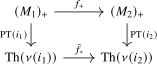
commutes up to based homotopy. More generally, for a smooth vector bundle \(E\) over \(M_2\), the square
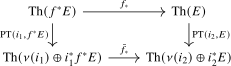
commutes up to based homotopy.
Proof sketch. Choose Riemannian metrics and tubular neighborhoods. An isotopy of embeddings has a tubular neighborhood over the parameter interval, which gives the homotopy in (1). For (2), choose nested tubular neighborhoods for \(N \subseteq P \subseteq Q\); collapsing successively then agrees with collapsing the resulting tubular neighborhood of \(N\) in \(Q\). For (3), transversality identifies the normal bundle of \(N_1\) with \(\bar f^*\nu (i_2)\). In tubular coordinates, rescaling the normal directions deforms \(f\) to its normal derivative. After shrinking the collapse radius, this gives a homotopy constant outside a fixed compact neighborhood of \(N_1\). Applying the same argument to \(f^*E\to E\) and the zero-section embeddings of \(N_1\) and \(N_2\) proves twisted base change; the isotopy and composition arguments likewise apply in the total space of \(E\). □