Proposition 3.3.17 (Cellular boundary formula). Let \(X\) be an anima with a CW-structure, and let \(n \geq 2\). Then the cellular boundary map is given at the generator \(e^n_{\alpha }\) by \[ d_n(e^n_{\alpha }) \;=\; \sum _{\beta \in I_{n-1}} d_{\alpha \beta } \cdot e^{n-1}_{\beta }, \] where the sum is over the set of \((n-1)\)-cells, and \(d_{\alpha \beta }\) is the degree of the composite map \[ \Delta _{\alpha \beta }\colon S^{n-1} \xrightarrow {\phi _{\alpha }} X^{n-1} \xrightarrow {q} X^{n-1}/X^{n-2} \simeq \bigvee _{\gamma \in I_{n-1}} S^{n-1}_{\gamma } \xrightarrow {p_{\beta }} S^{n-1}_{\beta }. \] Here \(q\) is the quotient map and \(p_{\beta }\) is the projection onto the \(\beta \)-th wedge summand.
Proof. Recall that \(d_n\) is the composite \[ \widetilde H_n(X^n/X^{n-1}) \xrightarrow {\partial _n} H_{n-1}(X^{n-1}) \xhookrightarrow {j_{n-1}} \widetilde H_{n-1}(X^{n-1}/X^{n-2}), \] where \(\partial _n\) is the connecting homomorphism and \(j_{n-1} = q_*\) is induced by the quotient map \(q\). Let \[ \iota _{\alpha }\colon S^n \; \hookrightarrow \; \bigvee _{\gamma \in I_n} S^n_{\gamma } \; \cong \; X^n/X^{n-1} \] be the inclusion of the \(\alpha \)-th wedge summand. The generator \(e^n_{\alpha } \in \widetilde {H}_n(X^n/X^{n-1})\) is the image of the generator \([\iota _n] \in \widetilde {H}_n(S^n)\) under the map on homology induced by \(\iota _{\alpha }\). The map \(\iota _{\alpha }\) may alternatively be obtained from the attaching map \(\phi _{\alpha }\colon S^{n-1} \to X^{n-1}\) by passing to cofibers in the following diagram:
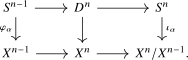
By the naturality of the boundary map, it follows that the top square in the following diagram commutes:
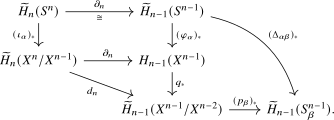
It follows that the image under \(d_n\) of the generator \(e^n_{\alpha }\) is the same as the image of \([\iota _{n-1}] \in \widetilde {H}_{n-1}(S^{n-1})\) of the middle vertical map. Under the isomorphism \(\widetilde {H}_{n-1}(X^{n-1}/ X^{n-2}) \cong \bigoplus _{\gamma \in I_{n-1}} \widetilde {H}_{n-1}(S^{n-1}_{\gamma })\), the \(\beta \)-th component is obtained by applying the projection \((p_{\beta })_*\). We conclude that \(d_{\alpha \beta }\) is the coefficient of the map \((p_{\beta } \circ q \circ \phi _{\alpha })_* = (\Delta _{\alpha \beta })_*\colon H_{n-1}(S^{n-1}) \to H_{n-1}(S^{n-1})\). By Remark 3.3.16, this is \(\deg (\Delta _{\alpha \beta })\). □