Proposition 11.1.4. Consider objects \(X\) and \(Y\) of \(C\) and consider a morphism \(\ev \colon Y \otimes X \to \unit \) in \(C\). The following conditions are equivalent:
- (1)
-
The morphism \(\ev \colon Y \otimes X \to \unit \) exhibits \(Y\) as a dual to \(X\).
- (2)
-
For all objects \(Z\) and \(W\) of \(C\), the composite \[ \Hom _{C}(W,Z \otimes Y) \xrightarrow {- \otimes X} \Hom _{C}(W \otimes X, Z \otimes Y \otimes X) \xrightarrow {\ev \circ -} \Hom _{C}(W \otimes X, Z) \] is an equivalence.
- (3)
-
The map in (2) is an equivalence for \((W,Z) = (\unit ,X)\) and for \((W,Z) = (Y,\unit )\).
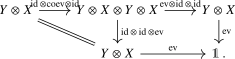
Proof. We first show that (1) implies (2). Let \(\coev \colon \unit \to X \otimes Y\) be the corresponding coevaluation map. It then follows directly from the triangle identities that an inverse to the map in (2) is given by the composite \[ \Hom _{C}(W \otimes X, Z) \xrightarrow {- \otimes Y} \Hom _{C}(W \otimes X \otimes Y, Z \otimes Y) \xrightarrow {- \circ \coev } \Hom _{C}(W,Z \otimes Y). \] The implication (2)\(\Rightarrow \)(3) is immediate. For (3)\(\Rightarrow \)(1), the first test produces the coevaluation and one triangle identity; the second detects the other triangle identity. Indeed, the test \((W,Z)=(\unit ,X)\) gives a map \(\coev \colon \unit \to X\otimes Y\) whose image is \(\id _X\), so the composite \[ X \xrightarrow {\coev \otimes \id } X \otimes Y \otimes X \xrightarrow {\id \otimes \ev } X \] is identified with \(\id _X\). The test \((W,Z)=(Y,\unit )\) gives an equivalence \[ \Hom _C(Y,Y) \xrightarrow {- \otimes X} \Hom _C(Y \otimes X, Y \otimes X) \xrightarrow {\ev \circ -} \Hom _C(Y \otimes X, \unit ). \] Both \(\id _Y\) and \((\ev \otimes \id )\circ (\id \otimes \coev )\) map to \(\ev \): for the latter, this follows from the first triangle identity and the commutative diagram
The two maps are therefore identified, proving the second triangle identity. □