Lemma 22.2.5. Let \(F\colon C \to D\) be a functor and let \(I\) be an \(\infty \)-category such that both \(C\) and \(D\) admit \(I\)-indexed limits. Then \(F\) preserves \(I\)-indexed limits if and only if the ‘canonical’ natural transformation \[ F(\lim _I (-)) \to \lim _I(F_*(-)) \] of functors \(\Fun (I,C) \to D\) is a natural isomorphism.
Proof. Consider the following commutative diagram:
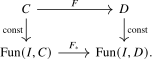
The ‘canonical’ transformation above is the one that under the adjunction \(\const \dashv \lim _I\) corresponds to the transformation \[ \const _{F(\lim _I(-))} \cong F_*(\const _{\lim _I(-)}) \to F_*(-) \] induced by the counit \(\const _{\lim _I(X)} \to X\). By Axiom K we may check that this map is an isomorphism for every fixed diagram \(X\colon I \to C\). But now we observe that the map \(F(\lim _I(X)) \to \lim _I(F_*(-))\) is an isomorphism if and only if the associated cone \(\const _{F(\lim _I(X))} \to F_*(X) = F \circ X\) is a limit cone, giving the claim. □