Proposition 6.3.27 (Long exact sequence of homotopy groups). Let \(C\) be a stable \(\infty \)-category equipped with a t-structure. For every exact sequence \(X \xrightarrow {f} Y \xrightarrow {g} Z\) in \(C\), we obtain a long exact sequence of homotopy groups in \(C^{\heartsuit }\): \[ \dots \to \pi _{n+1}(Z) \xrightarrow {\partial } \pi _n(X) \xrightarrow {\pi _n(f)} \pi _n(Y) \xrightarrow {\pi _n(g)} \pi _n(Z) \xrightarrow {\partial } \pi _{n-1}(X) \to \dots \]
Proof. Since every such exact sequence in \(C\) induces exact sequences \(Z[-1] \to X \to Y\) and \(Y \to Z \to X[1]\) and we have \(\pi _n(Z[-1]) = \pi _{n+1}(Z)\) and \(\pi _n(X[1]) = \pi _{n-1}(X)\), it suffices by induction to show that the sequence \[ \pi _0(X) \xrightarrow {\pi _0(f)} \pi _0(Y) \xrightarrow {\pi _0(g)} \pi _0(Z) \] is exact in \(C^{\heartsuit }\). We will prove this in progressively more general cases.
Case 1: Assume that \(X,Y,Z \in C_{\geq 0}\). We claim that in this case, the sequence \[ \pi _0(X) \to \pi _0(Y) \to \pi _0(Z) \to 0 \] is exact. To see this, it suffices to show that for every \(W \in C^{\heartsuit }\), the induced sequence of abelian groups \[ 0 \to \Hom _{C^{\heartsuit }}(\pi _0(Z),W) \to \Hom _{C^{\heartsuit }}(\pi _0(Y),W) \to \Hom _{C^{\heartsuit }}(\pi _0(X),W) \] is exact. Since \(Z \in C_{\geq 0}\), we have \(\pi _0(Z) = \tau _{\leq 0}Z\), so by adjunction we obtain isomorphisms \[ \Hom _{C^{\heartsuit }}(\pi _0(Z),W) \cong \pi _0\Hom _C(Z,W) \cong \pi _0 \hom _C(Z,W), \] and similarly for \(X\) and \(Y\). Furthermore, we have \(\pi _1\hom _C(X,W) \cong \pi _0\hom _C(X[1],W)\cong 0\) as \(\tau _{\leq 0}(X[1]) \cong 0\). The claim now follows from the long exact sequence on homotopy groups associated to the exact sequence of mapping spectra \[ \hom _C(Z,W) \to \hom _C(Y,W) \to \hom _C(X,W). \]
Case 2: Assume that \(X \in C_{\geq 0}\), but \(Y\) and \(Z\) are arbitrary. For every \(W\in C_{\leq -1}\), orthogonality and the exact sequence \(X\to Y\to Z\) identify \(\Hom _C(Z,W)\) with \(\Hom _C(Y,W)\). By adjunction and the Yoneda lemma in \(C_{\leq -1}\), the induced map \(\tau _{\leq -1}Y\to \tau _{\leq -1}Z\) is therefore an isomorphism, so we get a cofiber sequence \[ 0 \cong \tau _{\leq -1}X \to \tau _{\leq -1}Y \to \tau _{\leq -1}Z, \] showing that \(\tau _{\leq -1}Y \cong \tau _{\leq -1}Z\). Consider now the following diagram:
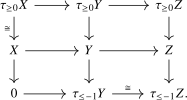
Since all three columns are exact and the bottom two rows are exact, it follows that the top row is also exact. Since \(\pi _0(X) \cong \pi _0(\tau _{\geq 0}X)\), and similarly for \(Y\) and \(Z\), the exactness of \(\pi _0(X) \to \pi _0(Y) \to \pi _0(Z) \to 0\) has thus been reduced to Case 1.
Case 3: Assume that \(Z \in C_{\leq 0}\), but \(X\) and \(Y\) are arbitrary. Using an argument dual to that of Cases 1 and 2, we obtain an exact sequence \[ 0 \to \pi _0(X) \to \pi _0(Y) \to \pi _0(Z). \]
Case 4: Finally, we consider the case for general \(X,Y,Z\). Let \(Q\) denote the cofiber of the composite \(\tau _{\geq 0}X \to X \to Y\). We then have the following commutative diagram:
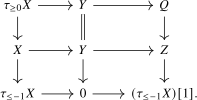
The three rows are exact, as are the left two columns, and hence so is the third column. Applying Cases 2 and 3, we get exact sequences \[ \pi _0(X) \to \pi _0(Y) \twoheadrightarrow \pi _0(Q) \to 0 \qquadtext { and } 0 \to \pi _0(Q) \hookrightarrow \pi _0(Z) \to \pi _{-1}(X). \] Gluing them together then gives the desired exact sequence \(\pi _0(X) \to \pi _0(Y) \to \pi _0(Z)\). □