Definition 10.3.1 (Normal \(B\)-structure). Let \(M\) be a compact smooth \(n\)-manifold. Its stable normal bundle \(\ul {\R ^n}-T_M\) is a virtual vector bundle of rank \(0\), with classifying map \(\nu _M\colon \Pi _\infty (M)\to \bB O\). A normal \(B\)-structure on \(M\) is a lift of this map along \(\phi \):
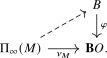
Concretely, this consists of a map \(\sigma \colon \Pi _\infty (M) \to B\) together with an identification \(\phi \circ \sigma \simeq \nu _M\). If \(M\) has boundary, choose a splitting \(T_M|_{\partial M}\cong \ul {\R }_{\mathrm {out}}\oplus T_{\partial M}\), where the first summand is trivialized by an outward-pointing vector field. This gives an identification \[ (\ul {\R ^n}-T_M)|_{\partial M}\cong \ul {\R ^{n-1}}-T_{\partial M}. \] The choices form a contractible space, so a normal \(B\)-structure on \(M\) restricts to one on \(\partial M\). A diffeomorphism of manifolds with normal \(B\)-structures is understood to be equipped with an identification in the anima of such lifts.