Definition 19.1.1 (Orthogonality). Let \(C\) be an \(\infty \)-category. A morphism \(l \colon A \to B\) is said to be left orthogonal to a morphism \(r \colon X \to Y\), written \(l \perp r\), if the following square is a pullback square:
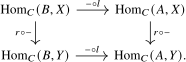
We then also say that \(r\) is right orthogonal to \(l\). Equivalently, for every solid commutative square

the anima of dashed fillers with compatible commutativity identifications for the two triangles is contractible; here compatibility means that pasting the triangles recovers the given square.
Given a collection of morphisms \(S\), we denote by \(S^\perp \) the collection of all morphisms that are right orthogonal to every morphism in \(S\), and by \({}^\perp S\) the collection of those that are left orthogonal to every morphism in \(S\).