Proposition 24.1.19. Let \(C\) be an \(\infty \)-category. For every object \(x \in C\), the functor \(t\colon C_{x/} \to C\) sending a morphism \(x \to y\) to its target \(y\) is a left fibration. Dually, the source functor \(s\colon C_{/x} \to C\) is a right fibration.
Proof. We prove the case for \(t\colon C_{x/} \to C\); the other case is dual. Consider a morphism in \(C_{x/}\), which takes the form of a commutative triangle

To show that this morphism is cocartesian with respect to the target functor \(t\colon C_{x/} \to C\), we have to show that for every third object \(x \to w\), the top square in the following commutative diagram is a pullback square:
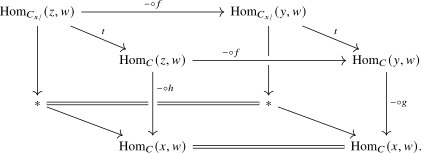
But this follows from the pasting law for pullback squares, since the bottom square and left/right faces are pullback squares. □