Construction 7.7. Let \(F\colon C \to D\) be a strongly continuous functor between dualizable categories. Then \(F\)
preserves \(\kappa \)-compact objects, since \(F^R\) preserves colimits, so it restricts to a functor \(F^{\kappa }\colon C^{\kappa } \to D^{\kappa }\). The left adjoint of
\(\colim \colon \Ind (C) \to C\) is the composite of \(\hat {y}\colon C \to \Ind (C^{\kappa })\) with the inclusion \(\Ind (C^{\kappa }) \subseteq \Ind (C)\): indeed, by the proof of Proposition 3.17, the colimit functor of \(\Ind (C)\) factors as
\(\colim _{\kappa } \circ r\), where \(r\) is the right adjoint of the inclusion \(\Ind (C^{\kappa }) \subseteq \Ind (C)\). Since \(\Ind (F)\) restricts to \(\Ind (F^{\kappa })\) on \(\Ind (C^{\kappa })\), Proposition A.27 gives a commutative square
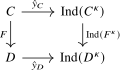 of strongly continuous functors. Passing to cofibers in \(\Pr ^{\mathrm {LL}}_{\st }\), which are computed in \(\PrL _{\st }\) by Proposition 7.1, we obtain a
strongly continuous functor \(\Ind (\Calk ^{\cont }_{\kappa }(C)) \to \Ind (\Calk ^{\cont }_{\kappa }(D))\). It preserves compact objects, and hence restricts to an exact functor \[ \Calk ^{\cont }_{\kappa }(F)\colon \Calk ^{\cont }_{\kappa }(C) \to \Calk ^{\cont }_{\kappa }(D). \]
The squares above are coherent in \(F\): the colimit functors form a natural transformation \(\Ind ((-)^{\kappa }) \to \id \), and taking
mates along \(\hat {y}_C \dashv \colim _C\) gives the natural maps \(\hat {y}_D F \to \Ind (F^{\kappa })\hat {y}_C\) used above. These are isomorphisms for strongly continuous \(F\),
by Proposition A.27. The compatibility of mates with composition supplies a natural transformation \(\id \to \Ind ((-)^{\kappa })\) in \(\Pr ^{\mathrm {LL}}_{\st }\). Applying
the cofiber functor and then taking compact objects therefore defines a functor \(\Calk ^{\cont }_{\kappa }\colon \Pr ^{\dual } \to \Cat _{\perf }\), including its higher
coherences.
Under the identifications of the quotients with kernels, the functor \(\Ind (\Calk ^{\cont }_{\kappa }(C)) \to \Ind (\Calk ^{\cont }_{\kappa }(D))\) is the restriction of \(\Ind (F^{\kappa })\). Indeed, the functors \(\colim _D \circ \Ind (F^{\kappa })\) and \(F \circ \colim _C\) preserve colimits and agree on \(C^{\kappa }\), so \(\Ind (F^{\kappa })\) maps \(\ker (\colim _C)\) into \(\ker (\colim _D)\). The left adjoint \(q_C\) of the inclusion \(\ker (\colim _C) \subseteq \Ind (C^{\kappa })\) is given by \(q_C(X) = \cofib (\hat {y}_C\colim _C X \to X)\). Using the square above, we get \(\Ind (F^{\kappa })(q_CX) \simeq q_D(\Ind (F^{\kappa })X)\), which identifies the functor induced on the quotients with the restriction of \(\Ind (F^{\kappa })\).