We freely use the calculus of mates in the homotopy \(2\)-category of categories, see [Kelly and Street (1974)] and [Riehl and Verity (2022)]. Since invertibility of a natural transformation can be checked objectwise in homotopy categories, all statements in this section only concern natural transformations up to homotopy.
Construction A.23. Consider a square of categories  commuting via a natural isomorphism \(\alpha \colon VG \simeq G'U\), and
suppose that \(G\) and \(G'\) admit left adjoints \(F\) and \(F'\), with units \(\eta ,\eta '\) and counits \(\varepsilon ,\varepsilon '\). The mate of \(\alpha \) is the natural
transformation \(\beta \colon F'V \to UF\) given by the composite \[ F'V \xrightarrow {F'V\eta } F'VGF \overset {\alpha }{\simeq } F'G'UF \xrightarrow {\varepsilon ' UF} UF. \] If instead \(U\) and \(V\) admit right adjoints \(U^R\) and \(V^R\), the vertical
mate of \(\alpha \) is the natural transformation \(\gamma \colon GU^R \to V^RG'\) given by \[ GU^R \to V^RVGU^R \overset {\alpha }{\simeq } V^RG'UU^R \to V^RG'. \] For a pullback square, the first formula gives the
Beck–Chevalley transformation used in [SHT, Definition 15.1.1]. Left adjointability there requires
this mate to be invertible.
Lemma A.24 (Conjugate transformations). Let \(F_1 \dashv G_1\) and \(F_2 \dashv G_2\) be adjunctions between categories \(A\) and \(B\), with
\(F_i\colon A \to B\). For every natural transformation \(\phi \colon F_1 \to F_2\) there is a unique natural transformation \(\phi ^{\vee }\colon G_2 \to G_1\), its conjugate, such that
the square 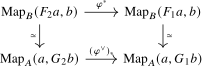 commutes naturally in \(a\) and \(b\). Moreover, \(\phi \) is an isomorphism if and only if \(\phi ^{\vee }\) is.
Proof.
The composite of the top map with the vertical isomorphisms is a natural transformation \(\Map _A(-,G_2(-)) \to \Map _A(-,G_1(-))\), which by the Yoneda lemma is induced by a unique natural transformation \(\phi ^{\vee }\colon G_2 \to G_1\). Again by the Yoneda lemma, \(\phi \) is an isomorphism if and only if \(\phi ^*\) is an isomorphism for all \(a,b\), if and only if \((\phi ^{\vee })_*\) is an isomorphism for all \(a,b\), if and only if \(\phi ^{\vee }\) is an isomorphism. □
Lemma A.25 ([Kelly and Street (1974), Section 2.2, Propositions 2.1 and 2.2]). In the situation of Construction A.23, assume that \(G,G'\) admit left adjoints \(F,F'\) and that \(U,V\) admit right adjoints \(U^R,V^R\). Then the mate \(\beta \colon F'V \to UF\) (a transformation between left adjoints of \(V^RG'\) and \(GU^R\)) is conjugate to the vertical mate \(\gamma \colon GU^R \to V^RG'\). In particular, \(\beta \) is an isomorphism if and only if \(\gamma \) is.
Lemma A.26 (Adjoint triples). Let \(F \dashv G \dashv H\) be an adjoint triple, with \(F,H\colon A \to B\) and \(G\colon B \to A\). Then \(F\) is fully faithful if and only if \(H\) is fully faithful.
Proof.
We have adjunctions \(GF \dashv GH\) and \(\id _A \dashv \id _A\). The unit \(\eta \colon \id _A \to GF\) of \(F \dashv G\) is a transformation between the left adjoints, and its conjugate is the counit \(\varepsilon \colon GH \to \id _A\) of \(G \dashv H\): indeed, under the identifications \(\Map _A(GFa,a') \simeq \Map _B(Fa,Ha') \simeq \Map _A(a,GHa')\), precomposition with \(\eta _a\) corresponds to postcomposition with \(\varepsilon _{a'}\), by the triangle identities. Now \(F\) is fully faithful if and only if \(\eta \) is an isomorphism, and \(H\) is fully faithful if and only if \(\varepsilon \) is an isomorphism, so the claim follows from Lemma A.24. □
The following was used in the definition of strongly continuous functors between compactly assembled categories, see Definition 3.9 and Remark 3.10.
Proposition A.27. Let \(C\) and \(D\) be compactly assembled categories, with left adjoints \(\hat {y}_C\) and \(\hat {y}_D\) of the colimit functors, and let \(f\colon C \to D\) be a functor with a right adjoint \(g\). Then the mate \[ \beta \colon \hat {y}_D f \to \Ind (f)\hat {y}_C \] of the commutative square \(\colim _D \circ \Ind (f) \simeq f \circ \colim _C\) is an isomorphism if and only if \(g\) preserves filtered colimits.
Proof.
Applying \(\Ind \) to the unit and counit of \(f \dashv g\) shows that \(\Ind (f) \dashv \Ind (g)\). By Lemma A.25, \(\beta \) is an isomorphism if and only if the vertical mate \[ \gamma \colon \colim _C\Ind (g) \to gf\colim _C\Ind (g) \simeq g\colim _D\Ind (f)\Ind (g) \to g\colim _D \] is an isomorphism. Evaluating at an object \(\quotcolim _i d_i \in \Ind (D)\), the map \(\gamma \) becomes \[ \colim _i g(d_i) \to gf\big (\colim _i g(d_i)\big ) \simeq g\big (\colim _i fg(d_i)\big ) \to g\big (\colim _i d_i\big ), \] whose restriction to each \(g(d_j)\) is \(g(d_j) \to gfg(d_j) \to g(d_j)\) followed by the canonical map \(g(d_j) \to g(\colim _i d_i)\). By the triangle identity, \(\gamma \) is therefore the canonical comparison map \(\colim _i g(d_i) \to g(\colim _i d_i)\). Hence \(\gamma \) is an isomorphism if and only if \(g\) preserves filtered colimits. □