Proposition 15.2.16. Let \(\Oo \) be a cocartesian operad and let \(\Pp \) be an \(\infty \)-operad such that the \(\infty \)-category \(\Pp ^{\otimes }\) is semiadditive. Then the underlying category functor induces an equivalence \[ \Fun _{\Op _{\infty }}(\Oo ,\Pp ) \iso \Fun (U(\Oo ),U(\Pp )) \] between operad maps \(\Oo \to \Pp \) and functors \(U(\Oo ) \to U(\Pp )\).
Proof. Picking an equivalence \(\Oo \simeq \OpCocart (C)\) for some \(C\), we may identify \(U(\Oo )\) with \(C\). The inclusion \(U(\Oo ) \hookrightarrow \Oo ^{\otimes }\) then corresponds to the composite \(C \hookrightarrow \Span (\Fin ) \times C \xrightarrow {\iota } C^{\amalg }\), where \(\iota \) is the functor from Construction 15.2.10. The functor in question then factors as \[ \Fun _{\Op _{\infty }}(\OpCocart (C),\Pp ) \iso \Fun (C,\CAlg (\Pp )) \to \Fun (C,U(\Pp )), \] where the first functor is the equivalence from Proposition 15.2.13(2) and the second functor is induced by \(\CAlg (\Pp ) \to U(\Pp )\) given by evaluation at \(\lra {1} \in \Span (\Fin )\). It thus remains to show that the latter is an equivalence. Unwinding definitions, we see that this map sits as the left vertical map in a diagram of fiber sequences in \(\Cat _{\infty }\) as follows:
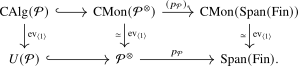
Since \(\Pp ^{\otimes }\) and \(\Span (\Fin )\) are semiadditive, Proposition 5.3.17 shows that the middle and right vertical maps are equivalences, and the claim follows. □