Proposition 20.3.2 (Cocartesian semiring construction). The functor \[ \Cat _{\infty }^{\mathrm {coprod}}\longrightarrow \CMon (\Cat _{\infty }), \qquad C\longmapsto (C,\amalg ), \] has a canonical lax symmetric monoidal refinement, where the source carries \(\otimes _{\mathrm {coprod}}\) and the target carries the symmetric monoidal structure of Proposition 16.4.1.
Proof. The forgetful functor \(U\colon \Cat _{\infty }^{\mathrm {coprod}}\to \Cat _{\infty }\) is canonically lax symmetric monoidal: by Example 18.1.2, the multimorphisms in the source are functors preserving finite coproducts separately in each variable, and their inclusion into all functors is an operad map.
By Lemma 20.3.1, the multimorphism operad of \(\Cat _{\infty }^{\mathrm {coprod}}\) is semiadditive. Moreover, \(U\) preserves finite products, since they are computed by cartesian products of \(\infty \)-categories on both sides. The adjunction of Theorem 20.2.10 therefore gives a unique lift
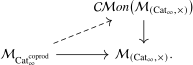
The upper-right \(\infty \)-operad is \(\Mm _{\CMon (\Cat _{\infty })}\) by Corollary 20.4.5. The lift therefore gives a lax symmetric monoidal functor to \(\CMon (\Cat _{\infty })\). On \(C\), its commutative monoid structure is induced by the biproducts in \(\Cat _{\infty }^{\mathrm {coprod}}\): the unit selects \(0_C\), and addition is the codiagonal \(C\times C\simeq C\oplus C\to C\). By the preceding lemma, this is the coproduct functor \(\amalg \colon C\times C\to C\), as required. □