Proposition 8.3.6 ([Lurie (2017), Proposition 7.1.1.13(1)]). Let \(R\) be a connective associative ring spectrum. Then the \(\infty \)-category \(\LMod _{R,\geq 0}\) is the smallest subcategory of \(\LMod _R\) which contains \(R\) and which is closed under colimits. The analogous statement holds for connective right \(R\)-modules.
Proof. The connective modules contain \(R\) and are closed under colimits. Conversely, for a connective module \(M\), we construct a sequence \(M(0)\to M(1)\to \cdots \) over \(M\) by successively killing the homotopy groups of the fibers; we enforce this by requiring the fiber \(K(i) := \fib (M(i)\to M)\) to be \(i\)-connective for each \(i \geq 0\).
Choose \(M(0)\to M\) from a coproduct of copies of \(R\) so that it is surjective on \(\pi _0\); then \(K(0)\) is connective. Given \(M(i)\to M\), choose a map \(g\colon F[i]\to K(i)\) which is surjective on \(\pi _i\), where \(F\) is a coproduct of copies of \(R\). Write \(\widetilde g\) for its composite with \(K(i)\to M(i)\), and form the pushout
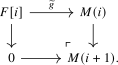
The nullhomotopy from the fiber sequence gives a map \(M(i+1)\to M\). The resulting fiber sequence \[ F[i]\longrightarrow K(i)\longrightarrow K(i+1) \] and surjectivity on \(\pi _i\) imply that \(K(i+1)\) is \((i+1)\)-connective.
Every \(M(i)\) belongs to the subcategory generated by \(R\) under colimits, since nonnegative shifts and cofibers are colimits. The fiber of \(\colim _i M(i)\to M\) is \(\colim _iK(i)\), since filtered colimits are exact. For each \(j\), the groups \(\pi _jK(i)\) vanish for \(i>j\), so Lemma 4.4.28 implies that this fiber is zero. Thus \(M\simeq \colim _iM(i)\), as required. The same construction works for right modules. □