Proposition 24.3.7. For a functor \(p\colon E \to C\), the following conditions are equivalent:
- (1)
-
The functor \(p\) is a left fibration;
- (2)
-
For every object \(e\) of \(E\), the induced functor \(p\colon E_{e/} \to C_{pe/}\) is an equivalence;
- (3)
-
The commutative square
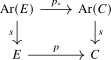
is a pullback square.
Proof. For \((1) \Rightarrow (2)\), assume that \(p\) is a left fibration. Since \(E_{e/} \to E\) and \(C_{pe/} \to C\) are left fibrations as well, it follows from Lemma 24.3.6 that also \(E_{e/} \to C_{pe/}\) is a left fibration, hence it is an equivalence if and only if each of its fibers is contractible. But the fiber over \(f \in C_{pe/}\) is the anima \(L(e,f)\) of \(p\)-cocartesian lifts of \(f\) starting in \(e\), hence this is contractible by Lemma 24.1.7.
For \((2) \Rightarrow (1)\), first note that it follows from (2) that every morphism \(pe \to c'\) has a lift to some morphism \(e \to e'\). It remains to show that every morphism \(\phi \colon e \to e'\) in \(E\) is \(p\)-cocartesian. But this is a direct consequence of Lemma 24.3.5: the two vertical maps in the square are equivalences, hence the square is a pullback square.
For \((2) \iff (3)\), note that the square is a pullback square if and only if the horizontal map in the following diagram is an equivalence:
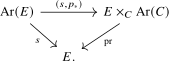
By the dual of Example 24.1.10, the two vertical functors are cartesian fibrations. In light of Theorem 24.3.1, the horizontal functor is an equivalence if and only if it induces equivalences on fibers over each object \(e \in E\). Unwinding definitions, these functors on fibers are the functors \(E_{e/} \to C_{pe/}\) from condition (2). □