Axiom C.2 (Pullbacks of \(\infty \)-categories). For functors \(f\colon C\to E\) and \(g\colon D\to E\), their pullback, or fiber product over \(E\), is an \(\infty \)-category \(C\times _E D\) with projections \(\pr _1\colon C\times _E D\to C\) and \(\pr _2\colon C\times _E D\to D\), and an identification \(\tau \colon f\circ \pr _1=g\circ \pr _2\); in other words, a commutative square of the form
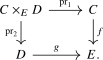
If \(C,D,E\) are animae, then \(C\times _E D\) is an anima. Given \(t_C\colon T\to C\), \(t_D\colon T\to D\), and \(\sigma \colon f\circ t_C=g\circ t_D\), there is a functor \(t=(t_C,t_D)_\sigma \colon T\to C\times _E D\) with identifications \(\alpha \colon \pr _1\circ t=t_C\), \(\beta \colon \pr _2\circ t=t_D\), and \[ \sigma \circ (f\star \alpha )=(g\star \beta )\circ (\tau \star t). \] For any \(h,k\colon T\to C\times _E D\), the functor \[ (h=k)\longrightarrow (\pr _1\circ h=\pr _1\circ k)\times _{(f\circ \pr _1\circ h=g\circ \pr _2\circ k)}(\pr _2\circ h=\pr _2\circ k) \] induced by whiskering with the two projections is an equivalence. The two functors defining the pullback on the right are \[ \alpha \longmapsto (\tau \star k)\circ (f\star \alpha ), \qquad \beta \longmapsto (g\star \beta )\circ (\tau \star h), \] and the identification needed to define the displayed functor is supplied by the interchange law.