Having established the basic language and constructions of \(\infty \)-categories, we now collect a small amount of
foundational infrastructure that will be used repeatedly later without further proof. Since our
ultimate interest in this book is stable homotopy theory and higher algebra, we treat the results
below as black boxes. Table 1.1 records additional background material developed later in the book.
Background material Discussed in Adjunctions and Kan extensions Chapter 22 Presheaves and free cocompletions Chapter 23 The Hom functor Section 24.4
The \(\infty \)-categories \(\Cat _\infty \) and \(\An \)
To formulate Yoneda-style constructions and presheaf categories, we need ambient \(\infty \)-categories of small animae and small \(\infty \)-categories. The following axiom isolates their key features that are used throughout this book.
Axiom M. There exist \(\infty \)-categories \(\An \) and \(\Cat _{\infty }\), together with a fully faithful functor \(\An \hookrightarrow \Cat _{\infty }\). They satisfy the following properties:
- There is a functor \(\pi _{\univ }\colon (\Cat _{\infty })_{\bullet } \to \Cat _{\infty }\) called the universal cocartesian fibration.1
Every object \(c \in \Cat _{\infty }\) defines an \(\infty \)-category \(C\) via the following pullback square: An \(\infty \)-category \(C\) arising this way is called a small \(\infty \)-category. If \(c\) is contained in the full subcategory \(\An \), then \(C\) is an anima; animae arising this way are called small animae.

- For objects \(c,d \in \Cat _{\infty }\) corresponding to \(\infty \)-categories \(C\) and \(D\), there is an equivalence of animae \[ \Hom _{\Cat _{\infty }}(c,d) \iso \Map (C,D), \] and in particular morphisms in \(\Cat _{\infty }\) correspond to functors of \(\infty \)-categories. Composition in \(\Cat _{\infty }\) corresponds to composition of functors.
- The \(\infty \)-categories \(\An \) and \(\Cat _{\infty }\) admit all small limits and colimits; here the adjective ‘small’ means that the indexing \(\infty \)-category is required to be small. The inclusion \(\An \hookrightarrow \Cat _{\infty }\) preserves small limits and colimits.
- The initial and terminal \(\infty \)-categories are small. Small \(\infty \)-categories are closed under products, coproducts, pullbacks, pushouts, functor categories, subcategories, and localizations.
- There is a fully faithful functor \[ \simp \hookrightarrow \Cat _{\infty } \] given on objects by sending a linearly ordered set \(P\) to its associated \(\infty \)-category. In particular, the \(\infty \)-categories \([n]\) are small for all \(n \geq 0\).
- There is a fully faithful functor \[ \Set \hookrightarrow \An \] given on objects by sending a set to its associated anima.
Remark 1.8.1 (Large \(\infty \)-categories). The \(\infty \)-categories \(\An \) and \(\Cat _{\infty }\) are sometimes referred to as the universe of animae and the universe of \(\infty \)-categories. It will sometimes be convenient to assume there are two more such universes \(\widehat {\An }\) and \(\widehat {\Cat }_{\infty }\) that satisfy all the same conditions as \(\An \) and \(\Cat _{\infty }\), with the following two further conditions:
- There is a fully faithful inclusion \(\Cat _{\infty } \hookrightarrow \widehat {\Cat }_{\infty }\) which on small animae restricts to a functor \(\An \hookrightarrow \widehat {\An }\);
- The \(\infty \)-categories \(\An \) and \(\Cat _{\infty }\) are small with respect to \(\widehat {\Cat }_{\infty }\).
These inclusions preserve small limits and colimits. We will refer to \(\infty \)-categories that are small with respect to \(\widehat {\Cat }_{\infty }\) as large \(\infty \)-categories. The two points may thus be summarized by saying that every small \(\infty \)-category is also large, and that the \(\infty \)-categories \(\An \) and \(\Cat _{\infty }\) are large.
All categorical constructions are understood relative to fixed ambient universes, which we silently enlarge when necessary.
Remark 1.8.2 (Two meanings of ‘pullback square’). The ambient \(\infty \)-category \(\Cat _{\infty }\) lets us reconcile two pieces of terminology that we have so far used in parallel. In Section 1.3 we defined products, coproducts, pullbacks and pushouts of \(\infty \)-categories, together with the corresponding notions of pullback and pushout square, purely in terms of functors and identifications. In Section 1.7 we defined limits and colimits inside an \(\infty \)-category, and hence in particular inside \(\Cat _{\infty }\). For small \(\infty \)-categories the two notions agree:
- A commutative square of functors in the sense of Definition 1.2.2 between small \(\infty \)-categories is the same thing as a commutative square in \(\Cat _{\infty }\) in the sense of Definition 1.4.1. Indeed, by Axiom M the hom animae of \(\Cat _{\infty }\) are the mapping animae \(\Map (C,D)\), so filling a square of functors amounts to giving an identification between the two composites.
- Such a square is a pullback square of \(\infty \)-categories in the sense of Section 1.3 if and only if it is a pullback square in \(\Cat _{\infty }\) in the sense of Section 1.7, and similarly for pushouts, products and coproducts. For pullbacks and products, the first condition can be detected by bijectivity on \(\pi _0\) of the mapping animae out of every \(\infty \)-category \(T\), whereas the second is characterized by equivalences of these mapping animae. The former nevertheless suffices to conclude that the canonical functor to the pullback or product is an equivalence. The statements for pushouts and coproducts are dual.
The one point to keep in mind is a matter of universes: the definitions in Section 1.3 quantify over all \(\infty \)-categories \(T\), whereas a (co)limit in \(\Cat _{\infty }\) only tests against small ones. By Remark 1.8.1 this is harmless, since the constructions of Section 1.3 are compatible with enlarging the ambient universe. From now on we use the two readings interchangeably.
Remark 1.8.3. In the quasicategorical model for \(\infty \)-categories, the statements in Axiom M are proved by [Lurie (2009b)]. The quasicategory modeling \(\Cat _{\infty }\) is taken to be the homotopy coherent nerve of the Kan-enriched category of quasicategories, while the quasicategory modeling \(\An \) is the homotopy coherent nerve of the Kan-enriched category of Kan complexes.
Presheaves and free cocompletions
With these ambient \(\infty \)-categories in place, we can record the presheaf formalism that will be used repeatedly later.
Let \(C\) be an \(\infty \)-category. Then the hom animae \(\Hom _C(x,y)\) for \(x,y \in C\) assemble into a functor \[ \Hom _C\colon C\catop \times C \to \An \] called the Hom functor. Formally constructing this functor turns out to be surprisingly involved: it relies on the advanced concept of straightening/unstraightening from Chapter 24. We refer to Section 24.4 for a construction of the Hom functor.
Remark 1.8.4 (Functoriality of mapping animae). Applying the Hom functor construction to the large \(\infty \)-category \(\Cat _{\infty }\) gives a functor \[ \Map (-,-) := \Hom _{\Cat _{\infty }}(-,-)\colon \Cat _{\infty }\catop \times \Cat _{\infty } \to \An . \] By Axiom M, its value at \((C,D)\) is \(\Map (C,D)=\Fun (C,D)^{\simeq }\), which is small when \(C\) and \(D\) are small. Its action on morphisms is given by precomposition and postcomposition. Thus the Hom functor supplies the higher coherences needed to make these operations functorial in both variables. We use this functor, for example, when constructing the nerve in Definition 25.1.1. The same construction applies to large \(\infty \)-categories after enlarging the universe.
Definition 1.8.5. A presheaf on an \(\infty \)-category \(C\) is a functor \(F\colon C\catop \to \An \). We define the presheaf category of \(C\) as \[ \PSh (C) \quad := \quad \Fun (C\catop ,\An ). \] By currying, the Hom functor defines a functor \(Y\colon C \to \PSh (C)\) called the Yoneda embedding; for \(x \in C\) we refer to the presheaf \(Y(x) := \Hom _{C}(-,x)\) as the presheaf represented by \(x\). A presheaf is called representable if it is isomorphic to \(Y(x)\) for some \(x\).
The \(\infty \)-categorical analogue of the Yoneda lemma is even more important than its classical analogue:
Theorem 1.8.6 (Yoneda lemma, [Land (2021), Propositions 4.2.10 and 4.2.11]). For a presheaf \(F\) on \(C\) and an object \(x \in C\), evaluation at \(\id _x \in \Hom _C(x,x) = Y(x)(x)\) induces an equivalence \[ \Nat (Y(x),F) \iso F(x), \qquad (\phi \colon Y(x) \to F) \mapsto \phi (\id _x). \] In particular the Yoneda embedding \(Y\colon C \hookrightarrow \Fun (C\catop ,\An )\) is fully faithful.
The following two results will be proved in Corollary 24.6.8 and Corollary 22.2.9, respectively.
Proposition 1.8.7. The functor \(\Hom _C(-,-)\colon C\catop \times C \to \An \) preserves limits in both variables separately.
Proposition 1.8.8. The presheaf category \(\PSh (C)\) admits all small limits and colimits. The evaluation functors \(\ev _x\colon \PSh (C) \to \An \) preserve all small limits and colimits.
Exercise 1.8.9. Let \(C\) be an \(\infty \)-category. Deduce that the Yoneda embedding \(Y\colon C \hookrightarrow \PSh (C)\) preserves all limits that exist in \(C\).
While the inclusion of \(C\) into \(\PSh (C)\) preserves all limits, it does not in general preserve colimits. Instead, it freely adds colimits to \(C\), in the following sense:
Theorem 1.8.10 (Lurie (2009b), Theorem 5.1.5.6). Let \(C\) be a small \(\infty \)-category and let \(D\) be a large \(\infty \)-category admitting all small colimits. Then restriction along the Yoneda embedding \(Y\colon C \hookrightarrow \PSh (C)\) induces an equivalence \[ Y^*\colon \Fun ^{\colim }(\PSh (C),D) \quad \iso \quad \Fun (C,D), \] where the left-hand side denotes the full subcategory of colimit-preserving functors \(\PSh (C) \to D\).
More informally, this says that every functor \(u\colon C \to D\) admits a unique colimit-preserving extension \(Y_!(u)\colon \PSh (C) \to D\). This functor can be described directly in terms of the concept of left Kan extension, developed systematically in Section 22.4. Informally, a left Kan extension \(i_!(u)\colon E \to D\) of a functor \(u\colon C \to D\) along a functor \(i\colon C \to E\) is the best approximation to an extension of \(u\) to \(E\): its value at an object \(e\) of \(E\) is assembled as a colimit of the values \(u(c)\) over all maps \(i(c) \to e\). In the situation \(i = Y\) of the theorem, the full faithfulness of the Yoneda embedding guarantees that for \(e = Y(c)\), this Kan extension recovers \(u(c)\).
The special case \(C = *\) is the form that we will use most often in Part I. Since \(\PSh (*) \simeq \An \), it gives the following universal property.
Corollary 1.8.11 (Universal property of animae). Let \(D\) be a large \(\infty \)-category admitting all small colimits. Evaluation at \(* \in \An \) induces an equivalence \[ \ev _*\colon \Fun ^{\colim }(\An ,D) \quad \iso \quad D. \]
Given an object \(d \in D\), the inverse equivalence sends \(d\) to a functor of the form \[ \An \to D, \qquad X \mapsto \colim _X d, \] where the right-hand side denotes the colimit of the constant diagram with value \(d\), indexed by the anima \(X\).
Returning now to the simplicial language from Section 1.6, we may use this theorem to assign an \(\infty \)-category to every simplicial anima:
Construction 1.8.12 (Associated \(\infty \)-category). Every simplicial anima \(X\colon \simp \catop \to \An \) has an associated \(\infty \)-category \(\ac (X) \in \Cat _{\infty }\). To construct it, consider the inclusion \(\simp \hookrightarrow \Cat _{\infty }\) from Axiom M. By Theorem 1.8.10, this uniquely extends to a colimit-preserving functor \[ \ac \colon \sAn = \PSh (\simp ) \to \Cat _{\infty }. \] In particular, every simplicial set \(X\) (hence every quasicategory) defines an \(\infty \)-category \(\ac (X)\) by regarding it as a simplicial anima via the inclusion \(\sSet \hookrightarrow \sAn \).
Remark 1.8.13. Note that the composite \[ \Cat _1^{(1)} \xhookrightarrow {N} \sSet \hookrightarrow \sAn \xrightarrow {\ac } \Cat _{\infty } \] provides a way of associating an \(\infty \)-category to a classical 1-category. From this point forward, we stop working with Axiom B.1 and use this refined assignment. The two assignments agree on the indexing categories used so far in this chapter: on the linear orders \([n]\) this is the fully faithful functor \(\simp \hookrightarrow \Cat _{\infty }\) from Axiom M. For \([1] \times [1]\), \(\pushout \), and \(\pullback \), this follows by expressing their nerves as pushouts of representables and applying \(\ac \). For \([\omega ]\), it follows by writing its nerve as the sequential colimit of the nerves of its finite initial segments and using the finite- and infinite-string clauses of Axiom D.
Adjunctions
The last piece of black-box infrastructure we record here is the notion of an adjunction, which interacts closely with the limit and colimit constructions introduced above:
Definition 1.8.14. Let \(F\colon C \to D\) and \(G \colon D \to C\) be two functors. An adjunction between \(C\) and \(D\) consists of a natural isomorphism \[ \Hom _D(F(-),-) \cong \Hom _C(-,G(-)) \] of functors \(C\catop \times D \to \An \). We often write \(F \dashv G\) to indicate that such an isomorphism has been given.
As in classical category theory, adjunctions may equivalently be characterized in terms of a unit \(\eta \colon \id _C \to GF\) and a counit \(\epsilon \colon FG \to \id _D\) satisfying the triangle identities \((\epsilon F)(F\eta ) \cong \id _F\) and \((G\epsilon )(\eta G) \cong \id _G\). An important feature of adjunctions is that they can be characterized pointwise: given a functor \(F\colon C \to D\), if one can provide for every object \(Y\) of \(D\) a suitable object \(G(Y)\) of \(C\) equipped with a map \(\epsilon _Y\colon FG(Y) \to Y\) satisfying a suitable adjointness condition, then these objects automatically assemble into a right adjoint \(G\colon D \to C\), and the maps \(\epsilon _Y\) assemble into a counit \(\epsilon \) for the adjunction.
The theory of adjunctions is very rich and there is a lot to say about it. Details on the pointwise characterization of adjunctions, along with related concepts such as Kan extensions, (co)final functors, and Bousfield localizations, can be found in Chapter 22.
Example 1.8.15. Let us state as black boxes two fundamental examples of adjunctions we will use:
- (1)
-
(Path components) The fully faithful inclusion \(\Set \hookrightarrow \An \) admits a left adjoint \(\pi _0\colon \An \to \Set \) by Corollary 12.3.24 of [Cisinski et al. (2026)]. This functor preserves arbitrary products.
We call \(\pi _0(X)\) the set of path components of the anima \(X\). We often abuse terminology and refer to an anima as a set if it is in the essential image of the inclusion \(\Set \hookrightarrow \An \) (cf. Example 1.1.4).
- (2)
-
(Homotopy category) We say that an \(\infty \)-category \(C\) is a 1-category if the hom anima \(\Hom _C(X,Y)\) is a set for all \(X,Y \in C\). We denote by \[ \Cat _1 \hookrightarrow \Cat _{\infty } \] the full subcategory spanned by the 1-categories. Then this inclusion admits a left adjoint (see [Lurie (2009b), Section 1.2.3]) \[ \Ho \colon \Cat _{\infty } \to \Cat _1. \] Given an \(\infty \)-category \(C\), we refer to the 1-category \(\Ho (C)\) as its homotopy category; it has the same set of isomorphism classes of objects as \(C\), but has hom sets given by the set of path components of the hom anima of \(C\): \[ \Hom _{\Ho (C)}(X,Y) \cong \pi _0(\Hom _C(X,Y)). \]
Remark 1.8.16. The functor \(\Cat _1^{(1)} \to \Cat _{\infty }\) from Remark 1.8.13 lands in the full subcategory \(\Cat _1\) of \(1\)-categories, by Theorem 15.5.1 of [Cisinski et al. (2026)]. In particular, every classical 1-category defines a 1-category in the above sense. Conversely, every 1-category arises this way. We will use the phrase ‘classical 1-category’ if we wish to refer to the classical definition of categories in terms of sets of objects and morphisms.
Exercises
The opening exercises develop fluency with coproducts, pullbacks, hom animae, monomorphisms, and full subcategories.
Exercise 1.1. Show that coproducts of \(\infty \)-categories are disjoint: given \(\infty \)-categories \(C\) and \(D\), the commutative square

is a pullback square. In a similar spirit, show that for every functor \(f\colon C \to D\) the commutative square

is a pullback square. In both cases, explain also which commutative square is meant, that is, which identification between the composites makes it commute. Hint: use Axiom C.4.
Exercise 1.2. Consider two functors \(f\colon C \to E\) and \(g\colon D \to E\). Show that the commutative square
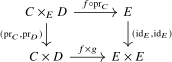
is a pullback square. In other words, construct an equivalence \[ C \times _E D \simeq (C \times D) \times _{E \times E} E. \] Hint: Consider the commutative diagram
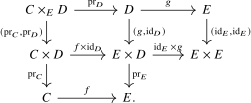
The vertical composite of the two left-hand squares is the square defining \(C \times _E D\). Use Exercise 1.3.10, Exercise 1.3.16, Lemma 1.3.15 to show that the bottom-left and top-right squares are pullback squares, and then apply pullback pasting twice.
Exercise 1.3. Let \(C\) and \(D\) be \(\infty \)-categories and let \(x,x' \in C\) and \(y,y' \in D\) be objects. Produce an equivalence \[ \Hom _{C \times D}((x,y), (x',y')) \simeq \Hom _C(x,x') \times \Hom _D(y,y'). \] Show that composition in \(C \times D\) corresponds to composition in \(C\) and \(D\) under these equivalences.
Exercise 1.4. Let \(f\colon C \to E\) and \(g\colon D \to E\) be functors, and let \(x,x' \in C \times _E D\) be objects. Show that there is a pullback square

Here the lower horizontal functor is induced by \(g\), followed by transport along the structural isomorphisms \(g\pr _D(x)\cong f\pr _C(x)\) and \(g\pr _D(x')\cong f\pr _C(x')\) carried by the two objects of the pullback.
Exercise 1.5. Show that a functor \(F\colon C \to D\) is a monomorphism if and only if the projection \(\pr _1\colon C \times _D C \to C\) is an equivalence.
Exercise 1.6. Let \(F\colon C\to D\) and \(G\colon C'\to D'\) be functors, and suppose there is a diagram
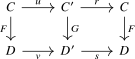
in which both squares commute and whose outer rectangle is isomorphic, as a commutative square, to the identity square on \(F\). In this situation, we say that \(F\) is a retract of \(G\).
Show that if \(G\) is a monomorphism, then so is \(F\). Conclude that if \(i\colon A \to C\) induces a monomorphism \(\Map ([1],A) \hookrightarrow \Map ([1],C)\), then it also induces a monomorphism \(A^{\simeq } \hookrightarrow C^{\simeq }\).
Exercise 1.7. Let \(i\colon A \to C\) be a monomorphism. Show that \(i^{\simeq }\colon A^{\simeq } \to C^{\simeq }\) is a monomorphism. Show that for every \(\infty \)-category \(T\), the functor \(i_*\colon \Fun (T,A) \to \Fun (T,C)\) is a monomorphism.
Exercise 1.8. Consider a pullback square of \(\infty \)-categories

Show that if \(i\) is a monomorphism, then so is \(i'\). Show moreover that if \(i\) is a full subcategory inclusion, then so is \(i'\).
The next exercise gives the concrete calculation needed for the subsequent localization arguments.
Exercise 1.9. The goal of this exercise is to show that the anima \(\Map ([1],[1])\) is equivalent to a disjoint union of three points.
- (1)
-
Construct a retraction \(r\) of the evaluation functor \[ e := (\ev _0,\ev _1)\colon \Map ([1],[1]) \to [1]^{\simeq } \times [1]^{\simeq }, \] that is, a map \(r\colon [1]^{\simeq } \times [1]^{\simeq } \to \Map ([1],[1])\) together with an equivalence \(r \circ e \simeq \id \).
Hint: consider the functor obtained from the ordinary minimum and maximum maps on \([1]\): \[ m\colon [1] \times [1] \times [1] \to [1], \qquad (x,y,z) \mapsto \min \bigl ( \max (x,y), \min (\max (x,z) , \max (y,z))\bigr ). \]
- (2)
-
Deduce from (1) that \(\Map ([1],[1])\) is a set. Under the equivalence \([1]^{\simeq } \times [1]^{\simeq } \simeq \{(0,0), (0,1), (1,0), (1,1)\}\), show that the fiber of \(e\) over \((1,0)\) is empty, while each of the other three fibers is inhabited.
- (3)
-
Conclude that the canonical map \[ * \sqcup * \sqcup * \to \Map ([1],[1]) \] selecting the three functors \(\const _0\), \(\id _{[1]}\), and \(\const _1\) is an equivalence.
The remaining exercises connect the walking morphism, localization, groupoid cores, and geometric realization. The final exercise uses the adjunction theory of Part III and may be postponed.
Exercise 1.10. Show that the functor \(p_{[1]}\colon [1] \to *\) exhibits \(*\) as the localization of \([1]\) at the collection \(W = \Map ([1],[1])\) of all morphisms.
- (1)
-
Show that \(p_{[1]}\) inverts all morphisms in \(\Map ([1],[1])\).
- (2)
-
Let \(D\) be an \(\infty \)-category. Use Chapterexercise 1.9 to rewrite the pullback square defining \(\Map ^{W}([1],D)\), and deduce that \(\Map ^{W}([1],D)\) is equivalent to \(\Iso (D)^{\simeq }\). Use the Rezk axiom to conclude that the functor \[ p_{[1]}^*\colon D^{\simeq } \to \Map ^{W}([1],D) \] is an equivalence.
- (3)
-
By Axiom L, let \(l\colon [1] \to L\) be a localization of \([1]\) at \(W\). Use the universal property of \(l\) together with (2) to show that for every \(\infty \)-category \(D\), the unique functor \(L \to *\) induces an equivalence \[ \Map (*,D) \to \Map (L,D), \] and thus is an equivalence.
Exercise 1.11. Let \(l\colon C \to L\) be a functor, and let \(W \hookrightarrow \Map ([1],C)\) be the collection defined by the pullback square
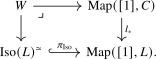
Show that \(l\) is a localization of \(C\) at some collection of morphisms if and only if it is a localization of \(C\) at this class \(W\).
Exercise 1.12. Show that any localization \(l\colon C \to L\) is essentially surjective: for any object \(x \in L\), there exists some \(y \in C\) with \(x \cong l(y)\). You may use without proof that every map of animae admits an image factorization. Hint: Apply this fact to \(C^{\simeq }\to L^{\simeq }\), let \(L' \subseteq L\) be the full subcategory on the resulting image collection, and apply the universal property of \(l\) to the map \(C \to L'\).
Exercise 1.13. Show that localizations are closed under pushouts: for a pushout square of \(\infty \)-categories

if \(l\) is a localization, then so is \(l'\).
Exercise 1.14 (cf. Proposition 1.4.4). Use the previous exercise to show that the two functors \[ p_0 \colon [1] \times [1] \to [2] \qquad \text { and }\qquad p_2 \colon [1] \times [1] \to [2] \] are localizations of \([1] \times [1]\) at the morphism \((0,0) \to (1,0)\) and \((0,1) \to (1,1)\), respectively; that is, at the left and the right column of the square. Here \(p_0\) and \(p_2\) are the functors constructed in Construction 1.4.3, pictorially represented by the following two diagrams:


Exercise 1.15. Let \(C\) be an \(\infty \)-category. Show that the following statements are equivalent:
- (1)
-
The \(\infty \)-category \(C\) is an anima;
- (2)
-
The functor \(p_{[1]}^*\colon C \to \Ar (C)\) is an equivalence;
- (3)
-
The functor \(p_{[1]}^*\colon C^{\simeq } \to \Map ([1],C)\) is an equivalence;
- (4)
-
The functor \(\pi _{\mathrm {Iso}}\colon \mathrm {Iso}(C) \to \Ar (C)\) is an equivalence.
Hint: Use Chapterexercise 1.10 and the Rezk axiom to show that \(p_{[1]}^*\colon C \to \Ar (C)\) identifies \(C\) with \(\Iso (C)\).
Exercise 1.16. Let \(C\) be an \(\infty \)-category. The goal of this exercise is to identify the groupoid core \(C^{\simeq }\) of \(C\) with the subcategory \(\lra {M}_C\) of \(C\) spanned by the isomorphisms \(M := \Iso (C)^{\simeq } \hookrightarrow \Map ([1],C)\).
- (1)
-
Show that \(M\) is closed under composition, so that the subcategory \(\lra {M}_C\) is defined.
- (2)
-
Show that the map \(p_{[1]}^*\colon \lra {M}_C^{\simeq } \hookrightarrow \Map ([1],\lra {M}_C)\) is an equivalence, and deduce from Chapterexercise 1.15 that \(\lra {M}_C\) is an anima.
- (3)
-
Show that the core functor \(\gamma _C\colon C^{\simeq } \to C\) sends all morphisms to isomorphisms, hence induces a functor \(C^{\simeq } \to \lra {M}_C\).
- (4)
-
Show that this functor induces an equivalence on groupoid cores. Use (2) to conclude that it is an equivalence.
Exercise 1.17. Let \(C\) be an \(\infty \)-category. The goal of this exercise is to show that its geometric realization \(\geom {C}\) is an anima.
- (1)
-
Use Chapterexercise 1.16 to show that the localization functor \(C \to \geom {C}\) factors through a functor \(C \to \geom {C}^{\simeq }\).
- (2)
-
Argue that this functor inverts all morphisms, hence induces a functor \(\geom {C} \to \geom {C}^{\simeq }\).
- (3)
-
Show that this provides an inverse to the inclusion \(\geom {C}^{\simeq } \to \geom {C}\) and conclude that \(\geom {C}\) is an anima.
Exercise 1.18. This exercise uses the theory developed in Chapter 22. Use the pointwise criterion for adjunctions (Lemma 22.1.4) to show that the inclusion \(\An \hookrightarrow \Cat _{\infty }\) admits both a left adjoint \(\geom {-}\colon \Cat _{\infty } \to \An \) as well as a right adjoint \((-)^{\simeq }\colon \Cat _{\infty } \to \An \).
Notes
1This terminology will be explained in Chapter 24.