Proposition 1.4.4 (Triangles as squares with an identity edge). For every \(\infty \)-category \(C\), the following two commutative squares are pullback squares:
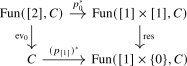
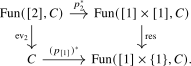
Here the functors labeled ‘res’ are given by precomposition with the inclusions of the left and right columns into \([1] \times [1]\).
Proof sketch. Factor each displayed square into two squares. The commutative-square case and the case \(n=2\) of Axiom D identify the resulting squares as pullbacks, and Lemma 1.3.15 finishes the argument. For details, see Corollary 2.2.8 of [Cisinski et al. (2026)]. □