The slice categories \(C_{/x}\) and \(C_{x/}\) consist of objects of \(C\) equipped with a morphism to or from \(x\). Their relative versions will index the pointwise formulas for Kan extensions.
Definition 22.3.1 (Slice category). Let \(C\) be an \(\infty \)-category and let \(x\) be an object in \(C\). We define the slice categories \(C_{/x}\) and \(C_{x/}\), also known as the over category and the under category, respectively, via the following two pullback squares:


Note that an object of \(C_{/x}\) is a pair \((y,f\colon y \to x)\) of an object \(y\) equipped with a morphism to \(x\), and dually objects of \(C_{x/}\) are pairs \((y,f\colon x \to y)\). As a result of Proposition 1.4.4 morphisms \((y,f) \to (y',f')\) in \(C_{/x}\) may equivalently be encoded by commutative triangles of the form

and dually for morphisms in \(C_{x/}\).
We denote by \[ s\colon C_{/x} \to C \qquadtext { and } t\colon C_{x/} \to C \] the assignments \(s(y,f\colon y \to x) = y\) and \(t(y,f\colon x \to y) = y\), i.e. we first include the slice into the arrow category \(\Ar (C)\) and then apply the source/target functor.
Lemma 22.3.2. Consider an object \(x\) of \(C\) and consider two objects \((y,f)\) and \((y',f')\) of the slice category \(C_{/x}\). Then the hom anima in \(C_{/x}\) sits in a pullback square of the form
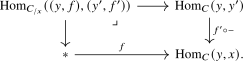
A dual formula holds for the hom animae of \(C_{x/}\).
Proof. By Chapterexercise 1.4, the hom anima in \(C_{/x}\) may be computed as the following pullback:

Using the equivalence \(\Fun ([1] \times [1],C) \simeq \Fun ([2],C) \times _{\Ar (C)} \Fun ([2],C)\) from Axiom D, the top right hom anima in \(\Ar (C)\) sits in a pullback square as follows:
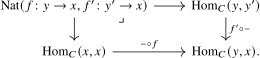
The claim thus follows by pasting pullback squares. □
Corollary 22.3.3. Let \(x\) be an object of \(C\). Then the slice category \(C_{/x}\) admits a terminal object \((x,\id _x)\), while \(C_{x/}\) admits an initial object \((x,\id _x)\).
Proof. The claim for \(C_{/x}\) is immediate from Lemma 22.3.2, since for every \((y, f) \in C_{/x}\) the induced map \(\id _x \circ -\colon \Hom _C(y,x) \to \Hom _C(y,x)\) is an equivalence, hence its fiber over \(f\) is contractible. The claim for \(C_{x/}\) is dual. □
Lemma 22.3.4. Let \(x\) be an object in an \(\infty \)-category \(C\).
- (1)
-
The object \(x\) is terminal in \(C\) if and only if the forgetful functor \(s\colon C_{/x} \to C\) is an equivalence;
- (2)
-
The object \(x\) is initial in \(C\) if and only if the forgetful functor \(t\colon C_{x/} \to C\) is an equivalence.
Proof. We prove (1); the proof of (2) is dual. If \(s\colon C_{/x}\to C\) is an equivalence, then \(x\) is terminal in \(C\) by Corollary 22.3.3, since equivalences preserve terminal objects. Conversely, suppose that \(x\) is terminal. Every object \(y\) of \(C\) admits a morphism \(y\to x\), so \(s\) is essentially surjective. By Lemma 22.3.2, the map \[ \Hom _{C_{/x}}((y,f),(y',f'))\longrightarrow \Hom _C(y,y') \] is a pullback of \(\{f\}\to \Hom _C(y,x)\). Since \(x\) is terminal, this last map is an isomorphism, and so \(s\) is fully faithful. We deduce \(s\) is an equivalence by Axiom J. □
Definition 22.3.5 (Relative slice category). For a functor \(F\colon C \to D\) and an object \(d\) of \(D\), we define the relative slice categories \(C_{/d}\) and \(C_{d/}\) via the following two pullback squares:


Objects of \(C_{/d}\) consist of pairs \((y,f\colon F(y) \to d)\), and objects of \(C_{d/}\) consist of pairs \((y,f\colon d\to F(y))\).
Remark 22.3.6. These relative slice categories are sometimes also denoted by \(F/d\) and \(d/F\), which makes their dependencies on \(F\) more transparent.