For an abelian group \(M\), the endomorphisms of \(M\) form a ring \(\End (M)\) under pointwise addition and composition. An \(R\)-module structure on \(M\) is the same as a ring homomorphism \(R\to \End (M)\). We prove the corresponding statement for an object of an \(\infty \)-category left-tensored over a monoidal \(\infty \)-category.
Let \(C\) be a monoidal \(\infty \)-category and let \(D\) be left-tensored over \(C\). For an object \(M \in D\), an object \(E \in C\) equipped with a morphism \(a\colon E \otimes M \to M\) is called an endomorphism object of \(M\) if composition with \(a\) induces an isomorphism \[ \Hom _C(X,E) \iso \Hom _D(X \otimes M,M) \] for every \(X\in C\). To construct its algebra structure, we first form an \(\infty \)-category of pairs \((A,\eta \colon A\otimes M\to M)\), with \(A\) an object of \(C\). Composition of these maps gives a monoidal structure on this \(\infty \)-category, in which \((E,a)\) is terminal. We use the coherent construction from Lurie (2017), Section 4.7.1 and explain how it gives the required algebra and its universal property.
Definition 17.3.1. Let \(D\) be left-tensored over a monoidal \(\infty \)-category \(C\), and let \(M\in D\). The endomorphism category of \(M\) is defined by the pullback
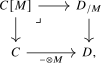
where the right vertical functor sends a morphism to its source.
An object of \(C[M]\) is equivalently a pair \((A,\eta )\) consisting of an object \(A \in C\) and a morphism \(\eta \colon A \otimes M \to M\). For two such objects, the mapping anima is \[ \Hom _{C[M]}((X,\zeta ),(A,\eta )) \simeq \Hom _C(X,A) \times _{\Hom _D(X\otimes M,M)} \{\zeta \}, \] where the map from \(\Hom _C(X,A)\) is induced by \(\eta \). Thus \((A,\eta )\) is terminal precisely when composition with \(\eta \) induces an isomorphism \[ \Hom _C(X,A)\iso \Hom _D(X\otimes M,M) \] for every \(X\in C\), which is exactly the endomorphism-object condition from the beginning of the section.
Composition of actions suggests a tensor product on \(C[M]\): \[ (A,\eta ) \otimes (A',\eta ') = \left (A \otimes A', A \otimes A' \otimes M \xrightarrow {\id _A \otimes \eta '} A \otimes M \xrightarrow {\eta } M\right ). \] The unit is \((\unit ,\unit \otimes M\simeq M)\). We quote the following theorem of Lurie, which supplies the coherent monoidal structure with this tensor product and unit, and identifies its algebras with algebra actions on \(M\).
Theorem 17.3.2 ([Lurie (2017), Proposition 4.7.1.30, Theorem 4.7.1.34]). Let \(D\) be left-tensored over a monoidal \(\infty \)-category \(C\), and let \(M \in D\). The endomorphism category \(C[M]\) admits a monoidal structure for which the forgetful functor \(C[M] \to C\) is monoidal. Moreover, there is an equivalence \[ \Alg (C[M]) \iso \LMod (D) \times _D \{M\} \] compatible with the forgetful functors to \(\Alg (C)\).
Under this equivalence, an algebra in \(C[M]\) is sent to its underlying algebra \(A\) together with the action \(A\otimes M\to M\).
Corollary 17.3.3 ([Lurie (2017), Corollary 4.7.1.40]). Let \(D\) be left-tensored over a monoidal \(\infty \)-category \(C\), and let \(M \in D\) admit an endomorphism object \(\End (M) \in C\). Then \(\End (M)\) admits a preferred structure of an associative algebra, and \(M\) admits a preferred structure of a left module over \(\End (M)\). Moreover, there is an equivalence of \(\infty \)-categories making the following diagram commute:

Proof. By definition, \(\End (M)\) is terminal in \(C[M]\). The monoidal structure from Theorem 17.3.2 and Corollary 14.6.12 therefore give \(\End (M)\) a unique associative algebra structure in \(C[M]\). Its image in \(C\) is an associative algebra, while its image under the equivalence of Theorem 17.3.2 is a left module structure on \(M\).
The forgetful functor \(\Alg (C[M]) \to \Alg (C)\) is a right fibration by [Lurie (2017), Proposition 4.7.1.39]. Since its total category has the terminal object just constructed, this right fibration is represented by \(\End (M)\). This gives the displayed equivalence. □