Let \(M\) be a closed smooth \(n\)-manifold. By Morse theory, \(M\) has the homotopy type of a finite cell complex [Milnor (1963), Theorem 3.5 and Corollary 6.7], so its suspension spectrum \(\S [M]\) is dualizable by Corollary 11.2.8. Atiyah duality identifies its dual geometrically: \[ D(\S [M])\cong \th (-T_M). \] Here \(-T_M\) is the inverse of the virtual tangent bundle \([T_M]\) and has virtual rank \(-n\); its Thom spectrum is defined as in Construction 10.2.18. We will prove this identification by constructing evaluation and coevaluation maps using Pontryagin–Thom collapse maps [Milnor and Spanier (1960); Atiyah (1961b)].
To construct these maps, we choose an embedding \(M\hookrightarrow \R ^N\) with normal bundle \(\nu \). The identification \(T_M\oplus \nu \cong \ul {\R ^N}\) expresses \(\th (-T_M)\) as the desuspension \(\th (\nu )[-N]\). We first recall why such an embedding exists.
Lemma 11.3.1. Let \(M\) be a compact smooth \(n\)-manifold. Then there exists a natural number \(N\) and a smooth embedding \(\phi \colon M \hookrightarrow \R ^N\).
Proof. By compactness, we may choose finitely many coordinate charts \(\phi _i\colon U_i \to \R ^n\), smaller open subsets \(V_i\) which still cover \(M\) and satisfy \(\overline {V_i}\subseteq U_i\), and smooth functions \(\rho _i\colon M \to [0,1]\) supported in \(U_i\) and strictly positive on \(V_i\). Extend \(\rho _i\phi _i\) by zero outside \(U_i\) and consider \[ \phi := (\rho _i\phi _i,\rho _i)_{i=1}^k\colon M \longrightarrow (\R ^n \times \R )^k. \] If \(x \neq y\), choose \(i\) with \(x \in V_i\). Equality of the \(i\)th pair of coordinates would force \(\rho _i(y)=\rho _i(x)>0\), hence \(y\in U_i\), and then \(\phi _i(y)=\phi _i(x)\), a contradiction. Thus \(\phi \) is injective. The same coordinate pair shows that \(d\phi \) is injective at \(x\): if it killed a tangent vector, then both \(d\rho _i\) and \(d(\rho _i\phi _i)=\rho _i d\phi _i+\phi _i d\rho _i\) would vanish, and hence so would \(d\phi _i\). Thus \(\phi \) is an injective immersion. Since \(M\) is compact, it is a smooth embedding. □
Remark 11.3.2. If \(n>0\), the Whitney embedding theorem shows that \(N\) can be chosen to be \(2n\) in the previous lemma.
For the remainder of this section, we will fix once and for all a smooth embedding \(\phi \colon M \hookrightarrow \R ^N\). We will denote by \(\nu := \nu _{\phi } \to M\) the normal bundle of this embedding, i.e., the cokernel of the map \(T_M \to \phi ^*(T_{\R ^N}) \cong \ul {\R ^N}\) of vector bundles over \(M\): \[ T_M \to \ul {\R ^N} \to \nu . \] By choosing a metric on the vector bundle \(\ul {\R ^N}\) one obtains an orthogonal decomposition \[ \ul {\R ^N} \cong T_M \oplus \nu . \] Passing to classes of virtual vector bundles and using Example 10.2.17, this gives \([T_M] + [\nu ] \cong [\ul {\R ^N}]\), so that \(-T_M\) is the virtual vector bundle \([\nu ] - [\ul {\R ^N}]\) of rank \(-n\). Hence Lemma 10.2.22 identifies \begin {equation} \label {eq:Thom_Spectrum_Negative_Tangent_Bundle} \th (-T_M) \cong \th (\nu )[-N] \cong \Sigma ^{\infty - N}(\Th (\nu )). \end {equation}
We will construct evaluation and coevaluation maps \[ \ev \colon \th (-T_M)\otimes \S [M]\to \S \qquadtext {and} \coev \colon \S \to \S [M]\otimes \th (-T_M). \] We first construct maps of pointed spaces, then specify the symmetries used to obtain these spectrum-level maps. Write \(\tau \) for the symmetry of a smash or tensor product.
Construction 11.3.3. For a continuous map \(f\colon X\to Y\) and a vector bundle \(E\to Y\), we abbreviate the map of Construction 10.1.7 as \[ f_*:=\Th (\widetilde f)\colon \Th (f^*E)\to \Th (E). \]
Example 11.3.4. For the terminal map \(p\colon M\to \pt \) and the bundle \(\R ^N\to \pt \), this gives \[ p_*\colon \Th (\ul {\R ^N})\cong S^N\wedge M_+\longrightarrow S^N. \] It is induced by the projection \(\R ^N\times M\to \R ^N\).
Example 11.3.5. The diagonal \(\Delta \colon M\to M\times M\) satisfies \(\Delta ^*(\nu \times \ul 0)\cong \nu \). It therefore induces the Thom diagonal \[ \Delta _*\colon \Th (\nu )\to \Th (\nu \times \ul 0)\cong \Th (\nu )\wedge M_+. \] This sends a vector \(v\in \nu _m\) to \(v\wedge m\) and the basepoint to the basepoint.
Recall the Pontryagin–Thom collapse map of Construction 10.1.9. We also need its twisted version.
Construction 11.3.6 (Twisted Pontryagin–Thom collapse map). Let \(i\colon N\hookrightarrow N'\) be a smooth embedding of compact smooth manifolds without boundary, and let \(E\to N'\) be a smooth vector bundle. The twisted collapse map has the form \[ \PT (i,E)\colon \Th (E)\to \Th \bigl (\nu (i)\oplus i^*E\bigr ). \] The composite of \(i\) with the zero section \(N'\hookrightarrow E\) has normal bundle \(\nu (i)\oplus i^*E\), using the canonical splitting of \(TE\) along the zero section. Choose a normalized tubular embedding of a closed disk bundle as in Construction 10.1.9. Its image is compact, so the collapse map on \(E\) is constant outside a compact subset and extends continuously to \(E^+\). The identification \(E^+\cong \Th (E)\) of Remark 10.1.4 gives the desired map. Normalized tubular isotopies give homotopies of these extensions, so its based homotopy class is independent of the choices.
Example 11.3.7. Our embedding \(\phi \colon M\hookrightarrow \R ^N\) gives a smooth embedding into \(S^N\) whose image avoids infinity. Choosing the tubular neighborhood to avoid infinity gives the pointed collapse map \[ \PT (\phi )\colon S^N\to \Th (\nu ). \]
Example 11.3.8. We identify the normal bundle of \(\Delta \colon M\hookrightarrow M\times M\) with \(T_M\) by \[ (T_M\oplus T_M)/T_M\xrightarrow {\ \cong \ }T_M,\qquad [(u,v)]\mapsto v-u, \] where the denominator is the diagonal subbundle. Identify \(\nu \) with the orthogonal complement of \(d\phi (T_M)\) in \(\ul {\R ^N}\). The twist \(E=\ul 0\times \nu \) then gives the specific trivialization \[ \nu (\Delta )\oplus \Delta ^*E\longrightarrow \ul {\R ^N}, \qquad ([(u,v)],w)\longmapsto d\phi (v-u)+w. \] With this trivialization, the twisted collapse map is \[ \PT (\Delta ,\ul 0\times \nu )\colon M_+\wedge \Th (\nu )\cong \Th (\ul 0\times \nu ) \longrightarrow \Th (\ul {\R ^N})\cong S^N\wedge M_+. \]
The point-set evaluation collapses away from the diagonal, combines its normal directions with \(\nu \) using this trivialization, and then forgets the point of \(M\): \[ \ev _0\colon M_+\wedge \Th (\nu ) \xrightarrow {\PT (\Delta ,\ul 0\times \nu )}S^N\wedge M_+ \xrightarrow {p_*}S^N. \] The point-set coevaluation collapses a tubular neighborhood of \(M\) and records the basepoint of the resulting normal vector: \[ \coev _0\colon S^N\xrightarrow {\PT (\phi )}\Th (\nu ) \xrightarrow {\Delta _*}\Th (\nu )\wedge M_+. \] We use the convention \(\Sigma ^{-N}(-)=\S [-N]\otimes -\) when passing to spectra. Thus the evaluation and coevaluation are the composites \[ \begin {aligned} \ev \colon \th (-T_M)\otimes \S [M] &\cong \Sigma ^{-N}\Sigma ^\infty (\Th (\nu )\wedge M_+)\\ &\xrightarrow {\Sigma ^{-N}\Sigma ^\infty \tau _{\Th (\nu ),M_+}} \Sigma ^{-N}\Sigma ^\infty (M_+\wedge \Th (\nu ))\\ &\xrightarrow {\Sigma ^{-N}\Sigma ^\infty \ev _0}\S ,\\[4pt] \coev \colon \S &\cong \Sigma ^{-N}\Sigma ^\infty S^N \xrightarrow {\Sigma ^{-N}\Sigma ^\infty \coev _0} \th (-T_M)\otimes \S [M]\\ &\xrightarrow {\tau _{\th (-T_M),\S [M]}} \S [M]\otimes \th (-T_M). \end {aligned} \] Note that the last symmetry in the coevaluation moves the desuspension factor as well as the Thom spectrum.
To finish the proof of Atiyah duality, it remains to show that these maps satisfy the space-level analogues of the triangle identities. We will use the following standard compatibilities of the Pontryagin–Thom construction. We formulate them only for compact manifolds without boundary, which is the case needed below.
Proposition 11.3.9 (Pontryagin–Thom calculus). Pontryagin–Thom collapse maps have the following properties, up to based homotopy.
- (1)
-
Isotopy invariance. An isotopy identifies the normal bundles of its endpoint embeddings through the normal bundle over the parameter interval. Under this identification, the collapse maps are homotopic. The same holds for twisted collapse maps when the twisting bundle is fixed.
- (2)
-
Compatibility with composition. Let \(N \xhookrightarrow {i} P \xhookrightarrow {j} Q\) be smooth embeddings of compact manifolds, and let \(E\) be a smooth vector bundle over \(Q\). After choosing a splitting of the normal-bundle sequence \[ 0 \to \nu (i) \to \nu (ji) \to i^*\nu (j) \to 0, \] the composite \[ \Th (E) \xrightarrow {\PT (j,E)} \Th (\nu (j) \oplus j^*E) \xrightarrow {\PT (i,\nu (j)\oplus j^*E)} \Th (\nu (i) \oplus i^*\nu (j) \oplus (ji)^*E) \] agrees up to homotopy with \(\PT (ji,E)\) under the resulting identification of target Thom spaces.
- (3)
-
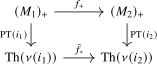
Transverse base change. Let \(f\colon M_1 \to M_2\) be a smooth map between compact smooth manifolds without boundary and let \(i_2\colon N_2 \hookrightarrow M_2\) be a closed smooth submanifold. Assume that \(f\) is transverse to \(N_2\), and set \(N_1 := f^{-1}(N_2)\), with inclusion \(i_1\colon N_1 \hookrightarrow M_1\) and induced map \(\bar f\colon N_1 \to N_2\). Then \(N_1\) is a smooth submanifold and there is a natural isomorphism \(\nu (i_1) \cong \bar f^*\nu (i_2)\). Under this identification, the square
commutes up to based homotopy. More generally, for a smooth vector bundle \(E\) over \(M_2\), the square
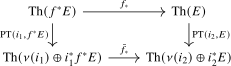
commutes up to based homotopy.
Proof sketch. Choose Riemannian metrics and tubular neighborhoods. An isotopy of embeddings has a tubular neighborhood over the parameter interval, which gives the homotopy in (1). For (2), choose nested tubular neighborhoods for \(N \subseteq P \subseteq Q\); collapsing successively then agrees with collapsing the resulting tubular neighborhood of \(N\) in \(Q\). For (3), transversality identifies the normal bundle of \(N_1\) with \(\bar f^*\nu (i_2)\). In tubular coordinates, rescaling the normal directions deforms \(f\) to its normal derivative. After shrinking the collapse radius, this gives a homotopy constant outside a fixed compact neighborhood of \(N_1\). Applying the same argument to \(f^*E\to E\) and the zero-section embeddings of \(N_1\) and \(N_2\) proves twisted base change; the isotopy and composition arguments likewise apply in the total space of \(E\). □
The evaluation map \(\ev \) has a homotopy class independent of the metrics and normalized tubular neighborhoods used in its construction.
Theorem 11.3.10 (Atiyah duality). The map \(\ev \) exhibits \(\th (-T_M)\) as a dual of \(\S [M]\), and hence determines an isomorphism: \[ D(\S [M])\cong \th (-T_M). \]
Proof. Write \(a_N\colon S^N\to S^N\) for the one-point compactification of \(-\id _{\R ^N}\), of degree \((-1)^N\). With the symmetries in the definitions of \(\ev \) and \(\coev \), the triangle identities follow from the point-set homotopies \[ (\id \wedge \ev _0)\circ (\coev _0\wedge \id ) \simeq (\id _{\Th (\nu )}\wedge a_N)\circ \tau _{S^N,\Th (\nu )}, \] \[ (\ev _0\wedge \id )\circ (\id \wedge \coev _0) \simeq \tau _{M_+,S^N}. \] The sources are \(S^N\wedge \Th (\nu )\) and \(M_+\wedge S^N\), respectively. The symmetry interchanging \(\S [-N]\) and \(\S [N]\) acts by \((-1)^{-N^2}=(-1)^N\); compare Warning 4.2.11. In the first triangle this cancels the map induced by \(a_N\); the second triangle has no remaining sphere interchange. We verify the second identity by a graph isotopy, and the first by the same method together with a rotation of the two normal-bundle summands.
We start with the first composite. Consider the following pullback square:
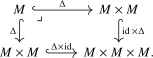
At \((m,m)\), the map induced by \(\Delta \times \id \) into the normal bundle of \(\id \times \Delta \) is \[ T_mM\oplus T_mM\longrightarrow T_mM,\qquad (v,w)\longmapsto w-v. \] It is surjective, proving transversality, and agrees with our normal-bundle convention for the diagonal. Apply transverse base change in Proposition 11.3.9 with twist \(\nu \times \ul 0\times \nu \).
For embeddings into \(S^N\times M\) or \(M\times S^N\), we choose tubular neighborhoods avoiding the fiber at infinity. Compactness permits this throughout the graph isotopies below, so the collapse maps descend to the reduced quotients. We use these reduced maps without further notation. Together with the definitions of \(\ev _0\) and \(\coev _0\), transverse base change gives the following homotopy-commutative diagram:
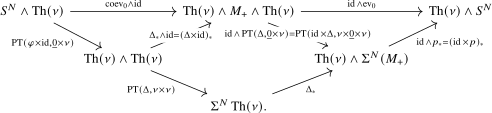
The top row is the first triangle composite. The upper two triangles commute by the definitions of \(\coev _0\) and \(\ev _0\), and the central diamond commutes by transverse base change. At the bottom vertex, the identification \(\Th (T_M\oplus \nu \oplus \nu )\cong S^N\wedge \Th (\nu )\) uses \((t,v,w)\mapsto (d\phi (t)+w,v)\); the outgoing pushforward places the \(\nu \)-factor first and records the point of \(M\) over which it lies. Compatibility with composition identifies the successive collapses with the twisted collapse for the graph embedding \[ j\colon M \xhookrightarrow {\Delta } M \times M \xhookrightarrow {\phi \times \id } S^N \times M, \] with twist \(\ul 0\times \nu \). To identify the whole composite, we must also track the bundle isomorphism used at the bottom vertex. For the isotopy \(j_s=(s\phi ,\id )\), identify the normal bundle with \(\ul {\R ^N}\) by \[ [(z,u)]\longmapsto z-s\,d\phi (u). \] At \(s=1\), write the normal coordinate as \(\eta =z-d\phi (u)=d\phi (t)+v\), with \(v\in \nu _m\). The convention \([(u_1,u_2)]\mapsto u_2-u_1\) for the diagonal sends the tangential component to \(-t\). Including the right diagonal maps, the triangle composite is therefore the graph collapse followed by the Thom map of \[ F\colon \ul {\R ^N}\oplus \nu \longrightarrow \nu \oplus \ul {\R ^N}, \qquad (d\phi (t)+v,w)\longmapsto (v,-d\phi (t)+w). \] Transport this identification along \(j_s\). At \(s=0\), the collapse for the zero graph is homotopic to the identity on \(S^N\wedge \Th (\nu )\) before applying the Thom map of \(F\). The base map in the right diagonal is \((\id \times p)\circ \Delta =\id _M\), so no further base map remains.
The bundle isomorphisms \[ (d\phi (t)+v,w)\longmapsto \bigl (\cos \theta \,v+\sin \theta \,w,\, -d\phi (t)-\sin \theta \,v+\cos \theta \,w\bigr ), \qquad 0\leq \theta \leq \pi /2, \] join \(F\) to \((\eta ,w)\mapsto (w,-\eta )\). Each map is an isomorphism: it is a rotation on the two normal summands and negation on the tangent summand. Their Thom maps give the first required homotopy.
For the second composite, apply the transposed pullback square. Take \(i_2 = \Delta \times \id \), \(f = \id \times \Delta \) and use the twist \(E = \ul {0} \times \nu \times \ul {0}\) over \(M \times M \times M\). Transverse base change and compatibility with composition identify the composite \((\ev _0 \wedge \id ) \circ (\id \wedge \coev _0)\) with the composite of the Pontryagin–Thom collapse map for the graph embedding \[ (\id ,\phi )\colon M \hookrightarrow M \times S^N \] and the Thom-space pushforward induced by \((p \times \id ) \circ \Delta = \id _M\). For the isotopy \((\id ,s\phi )\), the normal identification \([(u,z)]\mapsto z-s\,d\phi (u)\) agrees at \(s=1\) with our convention for the diagonal and the splitting \(T_M\oplus \nu \cong \ul {\R ^N}\). At \(s=0\), the reduced collapse is homotopic to the identity on \(M_+\wedge S^N\). Placing the sphere factor first gives \(\tau _{M_+,S^N}\), as required. □