Throughout the preceding chapters, an object of a category \(C\) has meant a functor \(x\colon A\to C\) from an arbitrary anima \(A\), called the context of the object. General anima contexts are essential for allowing interpretations of synthetic categories such as categories internal to a topos \(\mathcal{B}\). But in this generality, it is not immediately clear how to formulate and work with constructions involving objects.
For example, given a functor \(p\colon E \to C\) and an absolute object \(x\colon * \to C\), the fiber \(E_x\) is the pullback \(E \times_C *\). For an arbitrary object \(x\colon A \to C\), the corresponding construction is a category over \(A\):
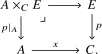 Questions about the fiber \(E_x\) translate into properties of the functor \(p\vert_A\). For example, asking the fiber \(E_x\) to be contractible translates to asking \(p\vert_A\) to be an equivalence. Asking it to admit a terminal object translates to asking \(p\vert_A\) to admit a right adjoint section.
In this chapter, we introduce the language of categories in context \(A\), and use them to express such objectwise constructions and properties in the usual categorical language. Semantically, categories in context \(A\) correspond to categories over \(A\). But by making them into primitive notions, we can require them to satisfy the same constructions and axioms as the absolute theory, allowing all results established so far to carry over. Every category \(C\) give rise to a category \(W_A C\) in context \(A\), called its weakening, which semantically corresponds to the constant family \(\pr_2\colon C \times A \to A\). Functors \(x\colon A\to C\) can then be reinterpreted as absolute objects of \(W_AC\) in context \(A\), allowing us to make statements about arbitrary objects using the language and notations of absolute objects.
We introduce categories in anima contexts and weakening in Section 5.1. In Section 5.2, we introduce dependent products and sums, which describe the category of sections and the total category of a family. We use these constructions in Section 5.3 to relate categories in context \(A\) to categories over \(A\). Finally, Section 5.4 discusses substitution along maps of animae and the conventions for leaving anima contexts implicit.
Sections
Categories in anima contexts
6 numbered results
Dependent products and sums
7 numbered results
Categories over an anima
17 numbered results
Changing the context
6 numbered results
Exercises Chapter 5
0 numbered results