This chapter develops the universe formalism needed in the rest of the book. We first construct categories of cocartesian functors and study straightening over the walking morphism. This first form of straightening extracts transport along a single arrow and supplies the input for directed univalence. We then formulate directed univalence, introduce the universe \(\Cat\) of small categories, and develop category theory internal to \(\Cat\). After constructing the universe \(\An\) of animae and the groupoid-core functor, we assemble the object-level and morphism-level classifications into the straightening/unstraightening equivalence. We conclude the discussion of straightening by recording some computations with unstraightening, and then turn to geometric realizations and localizations, including their fiberwise forms.
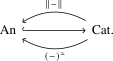
In more detail, the main purpose of this chapter is to introduce a synthetic category \(\Cat\) called the universe of small categories. It comes equipped with a cocartesian fibration \(\pi_{\univ}\colon \Cat_{\bullet} \to \Cat\) called the universal small cocartesian fibration. The conditions on \(\Cat\) and \(\pi_{\univ}\) will imply that all the constructions of synthetic category theory can be performed internally in the universe \(\Cat\). We will also construct the universe of small animae \(\An\) (historically often denoted \(\Ss\) and called the ‘\(\infty\)-category of spaces’ in the literature), together with its natural functors to and from \(\Cat\). The historical phrase does not identify animae with topological spaces.
A fundamental property that \(\pi_{\univ}\) is required to satisfy is directed univalence. To state what that says, note that to every object \(c\) of \(\Cat\) we may assign a synthetic category \(C\) by forming the following pullback:
 We will call a synthetic category \(C\) small if it is obtained in this way for a given object \(c\) of \(\Cat\). Directed univalence then demands that for two small categories \(C\) and \(D\), corresponding to objects \(c\) and \(d\) of \(\Cat\), the anima of morphisms from \(c\) to \(d\) in \(\Cat\) is equivalent to the anima of functors \(C \to D\); more precisely, we require the map
\[
\Hom_{\Cat}(c,d) \to \Map(C,D)
\]
to be an equivalence. Informally, this means that working with small categories and functors between them is the same as working with objects and morphisms of \(\Cat\), justifying the terminology ‘universe of small categories’.
Sections
The subcategory of cocartesian functors
15 numbered results
Straightening over the walking morphism
6 numbered results
Directed univalence
19 numbered results
The universe of categories
18 numbered results
Category theory internal to the universe
15 numbered results
The universe of animae
11 numbered results
Straightening/unstraightening
16 numbered results
Localizations
9 numbered results