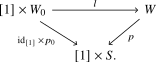
Construction 8.2.1. Let \(S\) be a category, let \(p\colon W \to [1] \times S\) be a cocartesian fibration, and denote by \(p_i\colon W_i \to S\) for \(i = 0,1\) the base change of \(p\) along the inclusion \((i,\id)\colon S \to [1] \times S\). We will construct a cocartesian functor over \([1] \times S\) of the form
 The functor \(l\) will be constructed as a dashed filler fitting in the following commutative diagram:
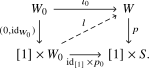 Observe that such a choice of lift is equivalent to finding a filler for the following commutative diagram:
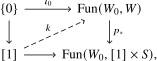 where the right vertical functor is given by postcomposition with \(p\) and the bottom map is adjoint to \([1] \times p_0 \colon [1] \times W_0 \to [1]\times S\). Equivalently, we need to find a morphism in \(\Fun(W_0,W)\) whose source is the inclusion \(\iota_0\colon W_0 \to W\) and which lifts the morphism in \(\Fun(W_0,[1] \times S)\) adjoint to \(\id_{[1]} \times p_0\colon [1] \times W_0 \to [1] \times S\). Since \(p_*\) is a cocartesian fibration by Proposition 4.5.13, we may simply choose \(k\) to be a cocartesian lift which starts in \(\iota_0\).
Unwinding the proof of Proposition 4.5.13, we obtain an explicit description of \(l\) at the level of objects: given an object \((\epsilon,w) \in [1] \times W_0\), write \(s := p_0(w) \in S\) and let \(u \colon 0 \to \epsilon\) denote the morphism in \([1]\) obtained from the fact that \(0 \in [1]\) is an initial object, see Lemma 4.4.22. Then we have \[ l(\epsilon,w) = (u,\id_s)_!(w), \] where the functor \((u,\id_s)_!\colon W_{(0,s)} \to W_{(\epsilon,s)}\) denotes cocartesian transport along the morphism \((u,\id_s)\colon (0,s) \to (\epsilon,s)\) in \([1] \times S\).