Lemma 8.1.9. The embedding \(M := \isCocart_{\Gamma}(f_{\univ}) \hookrightarrow \Map([1],\ulFun_S(C,D))\) forms a collection of morphisms in \(\ulFun_S(C,D)\) which is closed under composition, in the sense of Definition 3.1.6.
Proof
We first show that \(M\) is closed under identity maps. But this is clear: given a morphism \(f\) in \(\ulFun_S(C,D)\), the corresponding functors over \([1] \times \Gamma\) corresponding to \(\id_{f(0)}\) and \(\id_{f(1)}\) are given by pulling back the corresponding functor to \(f\) along the two maps \[ [1] \times \Gamma \to \{0\} \times \Gamma \hookrightarrow [1] \times \Gamma \qquadtext{ and } [1] \times \Gamma \to \{1\} \times \Gamma \hookrightarrow [1] \times \Gamma, \] and cocartesian functors are closed under base change, see Proposition 6.5.10.
We now show that \(M\) is closed under composition. Consider two morphisms \(f\) and \(g\) in \(\ulFun_S(C,D)\). By the Segal Axiom, we may just as well assume they arise as the restrictions of some map \(\sigma\colon [2] \times \Gamma \to \ulFun_S(C,D)\) along the two inclusions \([1]_{01} \hookrightarrow [2]\) and \([1]_{12} \hookrightarrow [2]\), where for \(0 \leq i < j \leq 2\) we write \([1]_{ij} \subseteq [2]\) for the subcategory spanned by \(i\) and \(j\). This map \(\sigma\) corresponds to a functor
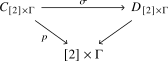 over \([2] \times \Gamma\). By assumption on \(f\) and \(g\), if we form the pullbacks of this map along the inclusions \([1]_{01} \times \Gamma \hookrightarrow [2] \times \Gamma\) and \([1]_{12} \times \Gamma \hookrightarrow [2] \times \Gamma\) we obtain cocartesian functors over \([1] \times \Gamma\). Our task is to show that also the pullback of this map along the inclusion \([1]_{02} \times \Gamma \hookrightarrow [2] \times \Gamma\) is a cocartesian functor over \([1] \times \Gamma\). To this end, consider a cocartesian morphism \(x_0 \to x_2\) in \(C\vert_{[1]_{02} \times \Gamma}\) living over the edge \(0 \to 2\). By cocartesian lifting, we may factor this morphism as a composite of two morphisms \(x_0 \to x_1\) and \(x_1 \to x_2\) living over \(0 \to 1\) and \(1 \to 2\), respectively. By the assumption on \(f\) and \(g\), these morphisms are then sent to cocartesian morphisms in \(D_{[1]_{01} \times \Gamma}\) and \(D_{[1]_{12} \times \Gamma}\), respectively. But then their composite must be a cocartesian morphism in \(D_{[1]_{02} \times \Gamma}\). This finishes the proof.