Lemma 19.6.12. With a six gluing functors datum as above, the functor \(i^!\colon X\to Z\) introduced in the previous remark is right adjoint to \(i_*\).
Proof
Given \(x\) in \(X\) and \(z\) in \(Z\), since \(i_*\) is fully faithful, it suffices
to prove that
\[
\Hom(i_*(z),i_*i^!(x))=\Hom(i_*(z),x)
\]
This will follow from an identification of the form
\[
\SpHom(i_*(z),i_*i^!(x))=\SpHom(i_*(z),x)
\]
by applying \(\Omega^\infty\).
By construction of \(i^!\), for any \(a\) and \(x\) in \(X\), we have
a pullback square of the form below.
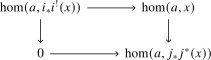 We want to prove that the upper horizontal map is invertible whenever \(a\) is of the form \(i_*(z)\).
By virtue of Lemma 19.6.6
it suffices to prove that
\[
\SpHom(i_*(z),j_*(u))=0
\]
for all \(z\) in \(Z\) and all \(u\) in \(U\). But \(j^*\) is left adjoint to \(j_*\) so that
this amounts to proving the relation \(j^*\circ i_*=0\). This follows from
the relation \(i^*\circ j_!=0\) and from Theorem 19.4.3 by transposition:
\[
\SpHom(a,j^*\, i_*(b))=\SpHom(i^*\, j_!(a),b)\, .
\]