Construction 8.6.5. Let \(p\colon C \to S\) be a cocartesian fibration. Consider a morphism \(u\colon x_0 \to x_1\) in \(C\), and write \(v = p(u)\) for the resulting morphism in \(S\). We then get a unique map \(\psi(u)\colon v_!(x_0) \to x_1\) in \(C_{s_1}\) fitting in the following commutative diagram:
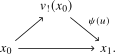 This process defines a functor
\[
\psi\colon \Map([1],C) \to \Map([1],C) \colon u \mapsto \psi(u).
\]
Observe that we have \(p(\psi(u)) = \id_{p(x_1)}\). We now define a collection of maps in \(C\) via the following pullback square:
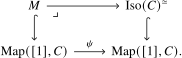 Observe that a morphism is in \(M\) if and only if it is \(p\)-cocartesian. Since the \(p\)-cocartesian morphisms in \(C\) are closed under composition by Proposition 6.5.4, it follows that the collection of maps \(M\) is closed under composition, and thus we may make the following definition: