Proposition 12.1.3. For a functor \(F\colon C \to \An\), let \(p_F\colon \int F \to C\) denote the small cocartesian fibration classified by \(F\). Then \(F\) is corepresentable if and only if \(\int F\) admits an initial object.
Proof
Let \(x\) be an object of \(C\). Observe that there is an equivalence between the following three types of data:
(1) Objects \(y\) of the fiber of \(p_F\) over \(x\).
(2) Functors \(\varphi\colon C_{x/} \to \int F\) over \(C\).
(3) Natural transformations \(\Hom_C(x,-) \to F\) of functors \(C \to \An\).
Directed univalence identifies the data in (2) and (3). For comparing (1) and (2), note that the slice \(C_{x/}\) has an initial object \((x,\id_x)\), so that the functor \((x,\id_x)\colon * \to C_{x/}\) is initial by Proposition 9.1.13. It follows from Remark 9.1.5 that for every object \(y\) of \(\int F\) satisfying \(p_F(y) = x\) there exists a unique functor \(\varphi\colon C_{x/} \to \int F\) fitting in the following commutative diagram:
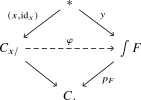 We claim that the object \(y\) is initial in \(\int F\) if and only if the corresponding natural transformation \(\Hom_C(x,-) \to F\) is a natural isomorphism of functors \(C \to \An\). Indeed, since directed univalence respects composition, the latter is equivalent to the condition that \(\varphi\colon C_{x/} \to \int F\) is an equivalence. Since \(\varphi\) is a morphism between left fibrations over \(C\), it is an equivalence if and only if it is an initial functor, see Lemma 9.1.6. By Proposition 9.1.8, this is in turn equivalent to \(y\colon * \to \int F\) being an initial functor, which by Proposition 9.1.13 happens precisely when \(y\) is initial in \(\int F\).