Construction 3.3.1. Let \(C\) be a category equipped with a collection of morphisms \(w\colon W \hookrightarrow \Map([1],C)\), in the sense of Definition 3.1.6. We will construct for every category \(D\) a full subcategory
\[
\Fun^W(C,D) \subseteq \Fun(C,D)
\]
In order to do this, we first define the anima \(\Map^W(C,D)\) via the following pullback square:
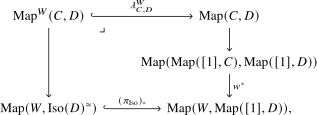 where the top right vertical map is the map from Construction 3.1.1. The bottom map is induced by the embedding \(\pi_{\Iso}^{\simeq}\) from Lemma 2.3.3 and hence is an embedding. It follows that also \(\lambda^W_{C,D}\) is an embedding. We can now define
\[
\Fun^W(C,D) := \langle \Map^W(C,D) \subseteq \Fun(C,D) \rangle.
\]
In particular, the map \(\lambda^W_{C,D}\) extends to a functor \(\tilde{\lambda}^W_{C,D}\colon \Fun^W(C,D) \to \Fun(C,D)\). We may think of the category \(\Fun^W(C,D)\) as the full subcategory of \(\Fun(C,D)\) spanned by those functors sending the morphisms in \(W\) to isomorphisms in \(D\).