Lemma 13.3.3. Let \(I\) be small and \(X\colon I \to \PSh(C)\). Then the canonical functor \[ p\colon \int_{i : I} C_{/X_i}\to C \] is a cartesian fibration.
Proof
Given a presheaf \(X\colon C\catop\to\An\), we will see \(C_{/X}\) through the following
pullback square
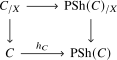 where \(h_C\) is the Yoneda embedding.
We construct cartesian lifts explicitly. Let \(u\colon i \to j\) be a morphism in \(I\),
with induced morphism \(u_!\colon X_i\to X_j\).
The explicit description of the Grothendieck construction
given in Remark 12.4.17
means that a morphism in \(\int_{i : I} C_{/X_i}\)
over \(f\colon a\to b\) in \(C\) amounts to a commutative square of the form
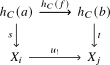 in \(\PSh(C)\), where \(u\colon i\to j\) is a morphism in \(I\).
Given an object \((j,b,t)\) and a morphism \(f\colon a\to b\) in \(C\), take \(u=\id_j\)
and the source \((j,a,t\circ h_C(f))\). Any morphism to \((j,b,t)\) lying over a
composite \(f\circ g\) factors uniquely through this morphism by the same
commutative triangle in \(\PSh(C)\). It is therefore \(p\)-cartesian.
These chosen lifts compose, so \(p\) is a cartesian fibration.