Proposition 12.1.9. Let \(f\colon C \to D\) be a functor. Then the left Kan extension functor \[ f_!\colon \Fun(C,\An) \to \Fun(D,\An) \] restricts to a functor \[ f\catop \colon C\catop \to D\catop. \]
Proof
Consider the induced adjunction
\[
f_!\colon \Fun(C,\An) \rightleftarrows \Fun(D,\An) \noloc f^*.
\]
For every object \(x\) of \(C\), we obtain a commutative square
 and it follows from the diagram
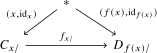 that \(f_{x/}\) is an initial functor, using the cancellation property (2) from Proposition 9.1.8. As a consequence, we obtain an identification
\[
f_!(\Hom_C(x,-)) = \Hom_D(f(x),-),
\]
and in particular \(f_!(\Hom_C(x,-))\colon D \to \An\) is corepresentable.