Proposition 3.3.7. Given a collection of morphisms \(W\) in a category \(C\) as well as a functor \(\lambda\colon C\to L\) sending all morphisms in \(W\) to isomorphisms in \(L\), assume that, for every category \(D\), the induced map \[ \lambda^*\colon\Map(L,D)\to\Map^W(C,D) \] is an equivalence. Then \(\lambda\) exhibits \(L\) as a localization of \(C\) at \(W\).
Proof
Let \(l\colon C\to C[W^{-1}]\) be a localization of \(C\) at \(W\). Then the induced map
\[
l^*\colon\Map(C[W^{-1}],D)\to\Map^W(C,D)
\]
is an equivalence because it is the map on groupoid cores induced by the equivalence
\(l^*\colon\Fun(C[W^{-1}],D)\iso\Fun^W(C,D)\). Since \(l\) inverts \(W\), the assumption on \(L\)
implies that there exists a functor \(u\colon L \to C[W^{-1}]\) equipped with an
identification \(u \circ \lambda = l\). To see that \(u\) is an equivalence, consider for every
category \(D\) the commutative triangle
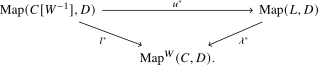 By Proposition 1.4.11, it suffices to show that \(u^*\) is an
equivalence for every category \(D\). This is immediate by the 2-out-of-3 property as
both diagonal maps are equivalences.
Thus \(u\) is an equivalence compatible with the maps out of \(C\), and the universal property of \(l\) transfers to \(\lambda\).