Remark 19.6.11. If we have a six gluing functors datum as above, then, for any object \(x\) of \(X\) the following square
induced by the co-unit of the adjunction \((j_!,j^*)\) and by the unit of the adjunction \((i^*,i_*)\)
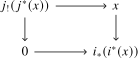 is a cofiber sequence in \(X\) (there is a unique way to make this square commutative
by condition (i)).
Indeed, it suffices to prove that the induced map from the cofiber of the co-unit
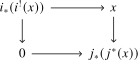
map \(j_!(j^*(x))\to x\) to \(i_*(i^*(x))\) is an isomorphism. By condition (v) of the definition, this means that it
suffices to check that the two commutative squares
 are cofiber sequences. But they are isomorphic to
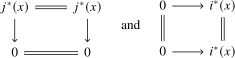 respectively, which are obviously cocartesian squares.
We define then a functor
\[
i^!\colon X\to Z
\]
by assigning to each \(x : X\) a fiber sequence of the form
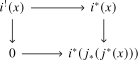 where the vertical map on the right side is the image by \(i^*\) of the unit
map of the adjunction \((j^*, j_*)\).
We can define \(I(x)\) through the pullback square
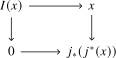 and observe that since \(j^*\) sends the vertical map on the right side to an isomorphism,
we have \(j^*(I(x))=0\). In other words the cofiber sequence
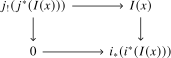 shows that the unit map \(I(x)\to i_*(i^*(I(x)))\) is an isomorphism.
Since \(i^*(I(x))=i^!(x)\) essentially by definition, we thus have
\[
I(x)=i_*(i^!(x))
\]
and this yields a canonical fiber sequence of the form below.
 Remark that since \(i_*\) is fully faithful, \(i^*\circ i_*\) is the identity and thus the fiber
sequence above may be taken as a definition of \(i^!(x)\) as well.
The following lemma explains why we speak of six gluing functors.