Proposition 7.9 ([Efimov (2024), Proposition 2.61]). The functor \(\Calk ^{\cont }_{\kappa }\colon \Pr ^{\dual } \to \Cat _{\perf }\) sends short exact sequences of dualizable categories to short exact sequences.
Proof.
Let \(C \xrightarrow {F} D \xrightarrow {G} E\) be a short exact sequence of dualizable categories. As shown above, \(C\) and \(D\) are \(\kappa \)-compactly
generated. Since \(G\) preserves \(\kappa \)-compact objects, [Ramzi (2024a), Proposition A.26] shows that \(C^{\kappa } \to D^{\kappa } \to E^{\kappa }\) is a short exact sequence. By Theorem 2.17(1), the
sequence \(\Ind (C^{\kappa }) \to \Ind (D^{\kappa }) \to \Ind (E^{\kappa })\) is a strongly continuous localization sequence. By Construction 7.7, we obtain a commutative diagram 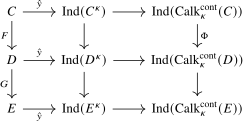 in
which the rows and the first two columns are cofiber sequences in \(\PrL _{\st }\). Since colimits commute with
colimits, the third column is a cofiber sequence in \(\PrL _{\st }\) as well.
We claim that \(\Phi \) is fully faithful. By Construction 7.7, \(\Phi \) is identified with the restriction of \(\Ind (F^{\kappa })\) to the kernels of the colimit functors. Since \(F\) is fully faithful, so are \(F^{\kappa }\) and \(\Ind (F^{\kappa })\), and hence so is \(\Phi \).
Since \(\Phi \) is fully faithful and colimit-preserving, its essential image is closed under colimits, and the cofiber sequence of the third column is a localization sequence by Proposition 2.12(1). All functors involved preserve compact objects, so it is strongly continuous. By Theorem 2.17(2), the sequence \(\Calk ^{\cont }_{\kappa }(C) \to \Calk ^{\cont }_{\kappa }(D) \to \Calk ^{\cont }_{\kappa }(E)\) of compact objects is short exact. □