Theorem 3.8 (Lurie, [Lurie (2018), Definition 21.1.2.1 and Theorem 21.1.2.10]). Let \(C\) be a category with filtered colimits. Then the following are equivalent:
- (1)
-
\(C\) is compactly assembled;
- (2)
-
There exists a small category \(D\) such that \(C\) is a retract of \(\Ind (D)\) as a category with filtered colimits.
Proof.
(1) \(\implies \) (2): We have an adjunction between \(\hat {y}\colon C \hookrightarrow \Ind (C)\) and \(\colim \colon \Ind (C) \to C\). Since \(\hat {y}\) is fully faithful, this exhibits \(C\) as a retract of \(\Ind (C)\), with both functors preserving filtered colimits. To ensure we may pick \(D\) small, write \(C = \Ind _{\kappa }(C^{\kappa })\), with \(C^{\kappa }\) small (Theorem A.17). Since \(\Ind (C) = \bigcup _{\lambda }\Ind (C^{\lambda })\) (Construction A.21) and \(C^{\kappa }\) is small, we may find some regular cardinal \(\lambda \) such that \(\hat {y}(C^{\kappa }) \subseteq \Ind (C^{\lambda })\). Since the inclusion \(\Ind (C^{\lambda }) \subseteq \Ind (C)\) preserves filtered colimits, it follows that in fact \(\hat {y}(C) \subseteq \Ind (C^{\lambda })\). So it follows that \(C\) is already a retract of \(\Ind (C^{\lambda })\), giving the claim.
(2) \(\implies \) (1): Assume we have \(u\colon C \hookrightarrow \Ind (D)\) with retraction \(v\colon \Ind (D) \to C\), and assume \(u\) and \(v\) preserve filtered colimits. It follows that \(C\) is accessible: we have \[ C = \lim \big ( \dots \xrightarrow {uv} \Ind (D) \xrightarrow {uv} \Ind (D)\big ), \] and the subcategory \(\mathrm {Acc} \subseteq \widehat {\Cat }\) of accessible categories and accessible functors is closed under limits in \(\widehat {\Cat }\) (Theorem A.18).
To show the existence of \(\hat {y}\), consider the following commutative diagram: 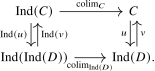 It follows that \(\colim _C\) is a retract
of \(\colim _{\Ind (D)}\). So we are done in light of Lemma A.22 in the appendix. □