We start with some recollections on the functor \(K\colon \Cat _{\st } \to \Sp \).
Definition 2.29. The Grothendieck group \(K_0(A)\) of a small stable category \(A\) is the free abelian group on the equivalence classes \([x]\) of objects \(x \in A\), modulo the relations \([x] = [x'] + [x'']\) for every cofiber sequence \(x' \to x \to x''\) in \(A\).
Nonconnective algebraic K-theory is a spectrum-valued refinement \(K\colon \Cat _{\st } \to \Sp \) of this construction, satisfying \(\pi _0K(A) \cong K_0(A)\) for \(A\) idempotent complete. Its fundamental property is that it is a localizing invariant in the following sense.
Definition 2.30. Let \(\Ee \) be a stable category. A functor \(F\colon \Cat _{\perf } \to \Ee \) is called a localizing invariant if \(F(0) \simeq 0\) and \(F\) sends short exact sequences (Definition 2.5) to fiber sequences. We extend \(F\) to \(\Cat _{\st }\) by setting \(F(A) := F(A^{\idem })\). We denote by \(\Fun _{\loc }(\Cat _{\st },\Ee )\) the full subcategory of localizing invariants.
By Theorem 2.17, a sequence \(A \to B \to C\) in \(\Cat _{\perf }\) is short exact if and only if \(\Ind (A) \to \Ind (B) \to \Ind (C)\) is a strongly continuous localization sequence in \(\PrL _{\st }\).
Lemma 2.31. Let \(\Ee \) be stable and let \(F\colon \Cat _{\st } \to \Ee \) satisfy \(F(0) \simeq 0\). Consider the following conditions:
- (1)
-
For every Verdier sequence \(A \hookrightarrow B \to B/A\) in the sense of Definition 2.4, \(F\) takes this sequence to a fiber sequence.
- (2)
-
Each sequence \(A \hookrightarrow B \to C\) with \(A \to B\) fully faithful and inducing an equivalence \((B/A)^{\idem } \iso C^{\idem }\) is sent to a fiber sequence under \(F\).
Then (2) implies (1), and (2) holds if and only if \(F\) satisfies (1) and inverts the maps \(A \to A^{\idem }\). In this case, \(F\) is (the extension of) a localizing invariant in the sense of Definition 2.30.
Proof.
The sequences in (1) are among those of (2). Suppose that \(F\) satisfies (1) and inverts idempotent completions. For a sequence as in (2), the fully faithful functor \(A^{\idem } \hookrightarrow B^{\idem }\) has thick image, so \[ A^{\idem } \hookrightarrow B^{\idem } \to B^{\idem }/A^{\idem } \] is a Verdier sequence. Moreover, \((B^{\idem }/A^{\idem })^{\idem } \simeq (B/A)^{\idem } \simeq C^{\idem }\), by the universal property of the idempotent complete quotient. Applying (1) and idempotent invariance therefore gives (2). Conversely, (2) applied to \(0 \to A \to A^{\idem }\) shows that \(F(A) \to F(A^{\idem })\) is an isomorphism. □
Remark 2.32. Condition (1) of Lemma 2.31 alone does not imply that \(F\) inverts \(A \to A^{\idem }\). For instance, connective algebraic K-theory satisfies (1) (see the proof of [Calmès et al. (2020), Corollary 4.4.15]), but \(K_0(A) \to K_0(A^{\idem })\) is in general not surjective. This is why localizing invariants are defined on idempotent complete categories.
Remark 2.33. One frequently additionally requires that \(\Ee \) is presentable and that \(F\) preserves filtered colimits (or at least \(\kappa \)-filtered colimits for some regular cardinal \(\kappa \)). Algebraic K-theory and \(\THH \) are examples of localizing invariants preserving filtered colimits. Topological cyclic homology \(\mathrm {TC}\) is localizing, but does not in general preserve filtered colimits.
Example 2.34. Let \(B = \lra {C,D}\) be a semiorthogonal decomposition in \(\Cat _{\perf }\) (Remark 2.24). Then every localizing invariant \(F\) sends the short exact sequence \(D \to B \to C\) to a fiber sequence \(F(D) \to F(B) \to F(C)\), which is split by \(F(i_C)\). Hence \[ F(B) \simeq F(C) \oplus F(D). \] Functors \(F\colon \Cat _{\perf } \to \Ee \) with this property are called additive.
Example 2.35. Let \(A \in \Cat _{\perf }\) and let \(F\) be a localizing invariant. The short exact sequence \(A \to \Ind (A)^{\omega _1} \to \Calk _{\omega _1}(A)\) of Definition 2.26 gives a fiber sequence \[ F(A) \to F(\Ind (A)^{\omega _1}) \to F(\Calk _{\omega _1}(A)). \] Since \(\Ind (A)^{\omega _1}\) admits countable coproducts, the middle term vanishes by an Eilenberg swindle: for \(T = \bigoplus _{\N }\colon \Ind (A)^{\omega _1} \to \Ind (A)^{\omega _1}\) we have \(\id \oplus T \simeq T\), and additivity gives \(F(\id ) + F(T) = F(T)\), so \(F(\id ) = 0\). Hence \[ F(A) \simeq \Omega F(\Calk _{\omega _1}(A)). \] This is the formula that will be used to extend \(F\) to dualizable categories, see Definition 1.9.
The most fundamental localizing invariant is nonconnective algebraic K-theory, as made precise by the following universal property.
Theorem 2.36. Nonconnective algebraic K-theory \(K\colon \Cat _{\perf } \to \Sp \) is the initial localizing invariant equipped with a natural transformation \((-)^{\simeq } \to \Omega ^{\infty }K(-)\).
Remark 2.37. In the literature, Theorem 2.36 is usually stated for localizing invariants preserving filtered colimits, see [Blumberg et al. (2013)] and also [Barwick (2016)]. The version without this condition is explicitly stated in [Ramzi (2024c), page 115, footnote 19]. That footnote does not supply a proof of the additional generality.
Definition 2.38 ([Blumberg et al. (2013)]). The category of localizing motives \(\mathrm {Mot}_{\loc }\) is the presentable stable category equipped with a localizing invariant \[ U_{\loc }\colon \Cat _{\perf } \to \mathrm {Mot}_{\loc } \] preserving filtered colimits, characterized as follows: for every presentable stable category \(\Ee \), precomposition with \(U_{\loc }\) induces an equivalence between colimit-preserving functors \(\mathrm {Mot}_{\loc }\to \Ee \) and localizing invariants \(\Cat _{\perf }\to \Ee \) preserving filtered colimits. We fix a universe for the small categories in \(\Cat _{\perf }\) and use a larger universe for functor categories; these size conventions are suppressed in the notation.
Although \(\mathrm {Mot}_{\loc }\) is defined by a universal property, it can be constructed explicitly as a localization of a category of spectral presheaves on a suitable small subcategory of \(\Cat _{\perf }\). This is the finitary category of motives. It is not asserted to classify all the localizing invariants of Definition 2.30.
Theorem 2.39 ([Blumberg et al. (2013), Theorem 9.8]). For all \(A \in \Cat _{\perf }\) there is a natural equivalence \[ \hom _{\mathrm {Mot}_{\loc }}\big (U_{\loc }(\Sp ^{\omega }),U_{\loc }(A)\big ) \simeq K(A). \]
Marc formulated the universal property of K-theory as follows.
Theorem 2.40 (Theorem/definition, cf. [Blumberg et al. (2013)]). \(K\) is the unit for the Day convolution operad structure on \(\Fun _{\loc }(\Cat _{\perf },\Sp )\), where localizing invariants are not required to preserve filtered colimits.
Explanation from Theorem 2.36.
The Day convolution unit on the full functor category is \(Y(A)=\Sigma ^{\infty }_+\Map (\Sp ^{\omega },A)\simeq \Sigma ^{\infty }_+(A^{\simeq })\). By Theorem 2.36, its canonical map to \(K\) induces an isomorphism on mapping animae into every localizing invariant. The same assertion applies in any variable of a Day multimorphism: with all other input categories fixed, its target has the form \(A\mapsto H(A\otimes B_1\otimes \cdots \otimes B_r)\), which is localizing because tensoring small idempotent complete stable categories preserves exact sequences. Taking the ends that express naturality in the remaining variables therefore shows that replacing a \(Y\)-input by \(K\) induces an isomorphism on multimorphism animae. This is the operadic unit property for \(K\). This argument uses the non-finitary universal property, not the universal property of \(\mathrm {Mot}_{\loc }\). □
Equivalently, one can work on \(\Cat _{\st }\) by extending each invariant along idempotent completion; in that formulation the unlocalized Day unit is corepresented by the finite spectra. No claim that the non-finitary category of invariants is presentable is needed here.
Theorem 2.41 (Tamme, before Efimov, [Tamme (2018), Theorem 18]). Consider a square \(Q\) in \(\Cat _{\st }\) of the form  Assume that \(\Ind (Q)\) is
cartesian, and that \(\Ind (f)\) and \(\Ind (g)\) are localizations. Then every localizing invariant \(F\) sends \(Q\) to a cartesian
square.
Proof.
Write \(h\colon B \to D\) for the right vertical functor and form the lax pullback \(P = B \times _D^{\to } C\). Its objects are triples \((b,c,\varphi )\) with \(\varphi \colon h(b) \to g(c)\). There is a split exact sequence \(C \to P \to B\), and hence \(F(P) \simeq F(C) \oplus F(B)\), by [Tamme (2018), Proposition 10]. The hypotheses make \(Q\) an excisive square in the sense of [Tamme (2018), Definition 14]; in fact only \(\Ind (g)\) needs to be a localization. By [Tamme (2018), Theorem 15], the functor \((b,c,\varphi ) \mapsto \cofib (\varphi )\) fits into an exact sequence \[ A \to P \to D. \] Here and in the split sequence, we may pass to idempotent completions before applying \(F\). Under the splitting, the map \(F(P) \to F(D)\) is \((-F(h),F(g))\): on \((b,0,h(b)\to 0)\) it is suspension followed by \(h\), and on \((0,c,0\to g(c))\) it is \(g\). Thus \(F(A)\) is the fiber of \(F(B)\oplus F(C) \xrightarrow {-F(h)+F(g)} F(D)\), compatibly with the maps of \(Q\). This is precisely the assertion that \(F(Q)\) is cartesian. □
Warning 2.42. One cannot replace the lax-pullback argument by simply applying \(F\) to the common kernel of \(f\) and \(g\). The hypotheses say that \(\Ind (f)\) and \(\Ind (g)\) are localizations; they do not say that \(f\) and \(g\) are Karoubi projections. Their small kernels therefore need not give short exact sequences to which \(F\) applies.
Remark 2.43. The proof above is Tamme’s lax-pullback argument and predates continuous K-theory. It applies to localizing invariants valued in any stable category, without assuming preservation of filtered colimits. A later proof using continuous invariants identifies the kernels of \(\Ind (f)\) and \(\Ind (g)\) and applies the continuous extension to the resulting localization sequences. See [Land and Tamme (2019)] for a generalization to arbitrary pullbacks of ring spectra.
Example 2.44 (Milnor patching, [Milnor (1971)]). Consider a pullback square of \(\bbE _1\)-rings:  and assume that \(A' \otimes _A A' \iso A'\). Then
the induced square
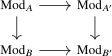 is also a pullback square, and \(\Mod _B \to \Mod _{B'}\) is a localization [Tamme (2018), Lemma 23 and Theorem 26]. In particular, we deduce:
Theorem 2.45 ([Tamme (2018), Theorem 28]; see also [Land and Tamme (2019)]). In the above situation, there is a pullback square 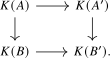
Example 2.46. Given a map of rings \(A \to B\) that sends an ideal \(I \subseteq A\) isomorphically to the induced ideal \(IB \subseteq B\), the
induced square  is a pullback of \(\bbE _1\)-rings.