A striking consequence of compact assembly is that it bounds the size of the generators: every compactly assembled category is generated by its \(\omega _1\)-compact objects, which moreover admit an explicit description. Recall the natural transformation \(\hat {y} \to y\) from Section 3.1.
Theorem 3.20 (Efimov, [Efimov (2024), Corollary 2.13 and Proposition 2.16]). Let \(C\) be compactly assembled.
- (1)
-
\(C\) is \(\omega _1\)-compactly generated.
- (2)
-
An object \(x\) of \(C\) is \(\omega _1\)-compact if and only if it can be written as \[ x = \colim \big ( \dots \to x_n \to x_{n+1} \to \dots \big ) \] where each map \(y(x_n) \to y(x_{n+1})\) factors as \[ y(x_n) \to \hat {y}(x_{n+1}) \to y(x_{n+1}). \]
The proof has two steps. First, interleaving identifies the finest presentation of a sequential colimit with a countable colimit of representables, giving the criterion in (2). Then countable directed pieces of an arbitrary presentation give the \(\omega _1\)-filtered presentation required in (1).
Proof.
We first prove (2). For \(\impliedby \), write \(x = \colim _n x_n\). Then \(\hat {y}(x) = \colim _n \hat {y}(x_n) = \colim _n y(x_n)\), where the last equality holds by considering 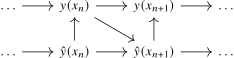 filled
with the given maps \(y(x_n) \to \hat {y}(x_{n+1})\). The top triangle commutes by construction. The fact that we can also make the
bottom triangle commute in a way that makes the total square agree with the canonical one follows
from the adjunction \(\hat {y} \dashv \colim \): after applying the adjunction, this square looks like
 Now, each \(y(x_n)\) is compact in \(\Ind (C)\),
and in particular \(\omega _1\)-compact, so also the colimit \(\hat {y}(x) = \colim _n y(x_n)\) is \(\omega _1\)-compact. But since \(\hat {y}\) is fully faithful and preserves
filtered colimits, this implies that \(x\) is already \(\omega _1\)-compact in \(C\).
For \(\implies \), consider \(x \in C\).
Observation: We may write \(\hat {y}(x) = \colim _{i \in I} y(x_i)\) for \(I\) a filtered poset. (Any filtered category admits a cofinal map from a filtered poset, see Theorem A.8.) By applying \(\colim \colon \Ind (C) \to C\), we get \(x = \colim _{i \in I} x_i\). Since \(\hat {y}\) preserves colimits, we get \(\hat {y}(x) = \colim _{i \in I} \hat {y}(x_i)\). Since each \(y(x_i)\) is compact, it follows that for each \(i \in I\) there exists some \(j \geq i\) such that the map \(y(x_i) \to y(x_j)\) factors through \(\hat {y}(x_j) \to y(x_j)\).
Now, assume \(x\) is \(\omega _1\)-compact. Then also \(\hat {y}(x)\) is \(\omega _1\)-compact in \(\Ind (C)\): by adjunction this follows because its right adjoint \(\colim \) preserves \(\omega _1\)-filtered colimits. Thus we may write \(\hat {y}(x) = \colim _n y(x_n)\) by Proposition A.13 (applied to \(\Ind (C^{\lambda }) \subseteq \Ind (C)\) for \(\lambda \) large enough that \(\hat {y}(x) \in \Ind (C^{\lambda })\), see Construction A.21). By the previous observation we see that for each \(n\) there exists some \(k \geq n\) such that the map \(y(x_n) \to y(x_k)\) factors through \(\hat {y}(x_k)\). By reindexing, we may assume \(k = n+1\), giving the claim.
Finally, we prove (1). As in the proof of Theorem 3.8, choose a regular cardinal \(\lambda \) such that \(\hat {y}(C) \subseteq \Ind (C^{\lambda })\), with \(C^{\lambda }\) essentially small. For \(x \in C\), choose a presentation \(\hat {y}(x) = \colim _{i\in I}y(x_i)\) with \(I\) a small filtered poset and \(x_i \in C^{\lambda }\). By the observation above, choose for each \(i\) an element \(s(i) \geq i\) such that \(y(x_i) \to y(x_{s(i)})\) factors through \(\hat {y}(x_{s(i)})\).
Let \(\Sigma _s\) be the poset of nonempty countable directed subsets \(Q \subseteq I\) closed under \(s\), ordered by inclusion. Every countable subset of \(I\) is contained in such a \(Q\): start with that subset and one element of \(I\), and repeatedly add the chosen successors and upper bounds for every pair. The union after countably many steps has the required properties. Applying this to countable unions shows that \(\Sigma _s\) is \(\omega _1\)-filtered and cofinal in the poset of all countable directed subsets. By Proposition A.9, \[ x \simeq \colim _{Q\in \Sigma _s}\colim _{i\in Q}x_i. \] For each \(Q\), enumerate its elements and choose a cofinal sequence \(i_0\leq i_1\leq \cdots \) in \(Q\) with \(i_{n+1}\geq s(i_n)\), by successively taking upper bounds with the next enumerated element. The transition \(y(x_{i_n})\to y(x_{i_{n+1}})\) factors through \(\hat {y}(x_{i_{n+1}})\), using the chosen factorization at \(s(i_n)\) and naturality of \(\hat {y}\to y\). Thus \(\colim _{i\in Q}x_i\) is \(\omega _1\)-compact by (2).
This writes every object as an \(\omega _1\)-filtered colimit of \(\omega _1\)-compact objects. These objects may be chosen from the essentially small collection of colimits of sequences in \(C^{\lambda }\). Every \(\omega _1\)-compact object is a retract of one of them, by factoring its identity through this presentation. Since \(C\) is locally small, the collection of these retracts is essentially small as well. Consequently \(C\) is \(\omega _1\)-compactly generated. □
For dualizable categories, there is an alternative and perhaps more intuitive argument for part (1) of Theorem 3.20, using the presentation as a kernel.
Alternative proof of Theorem 3.20(1) for \(C\) dualizable.
By Theorem 3.16, we may write \(C = \ker (L\colon D \to E)\) for a localization \(L\) between compactly generated categories which preserves compact objects. Since \(C \subseteq D\) is closed under colimits, every object of \(C\) which is \(\omega _1\)-compact in \(D\) is \(\omega _1\)-compact in \(C\).
Let \(x \in C\), and write \(x = \colim _{p \in P} d_p\) in \(D\) with \(P\) a filtered partially ordered set and \(d_p \in D^{\omega }\) (Theorem A.8). Then \(\colim _p L(d_p) \simeq L(x) \simeq 0\), and each \(L(d_p)\) is compact in \(E\). Hence for every \(p \in P\) there is some \(p' \geq p\) such that the map \(L(d_p) \to L(d_{p'})\) is nullhomotopic. Let \(\Sigma ' \subseteq \Sigma \) be the set of countable filtered subsets \(Q \subseteq P\) such that for every \(q \in Q\) there is some \(q' \in Q\) with \(q' \geq q\) and \(L(d_q) \to L(d_{q'})\) nullhomotopic. Arguing as in the proof of Proposition A.9, but alternately adding upper bounds and such witnesses \(q'\), one sees that every countable collection of elements of \(\Sigma \) has an upper bound in \(\Sigma '\). Hence \(\Sigma '\) is \(\omega _1\)-filtered and cofinal in \(\Sigma \), so by Proposition A.9 and Lemma A.7 we get \[ x \simeq \colim _{Q \in \Sigma '} x_Q, \qquad x_Q := \colim _{q \in Q} d_q. \] For \(Q \in \Sigma '\) we have \(L(x_Q) \simeq \colim _{q \in Q} L(d_q) \simeq 0\), since every transition map is eventually nullhomotopic, so \(x_Q \in C\). Moreover, \(x_Q\) is a countable colimit of compact objects, hence \(\omega _1\)-compact in \(D\) (Corollary A.4), and hence in \(C\). So every object of \(C\) is an \(\omega _1\)-filtered colimit of \(\omega _1\)-compact objects. □
Remark 3.21. By Lemma 3.5, the condition on the transition maps in Theorem 3.20(2) says precisely that the maps \(x_n \to x_{n+1}\) are compact morphisms. So the \(\omega _1\)-compact objects of a compactly assembled category are precisely the sequential colimits along compact morphisms, and every object is an \(\omega _1\)-filtered colimit of such. In Chapter 4 we will see that, conversely, a presentable stable category is dualizable if and only if it is generated under colimits by such sequential colimits. While compact objects are the right tool to study compactly generated categories, compact morphisms are the right tool to study dualizable ones.
As a first illustration of this principle, strongly continuous functors between dualizable categories can be detected using compact morphisms, just like functors between compactly generated categories are strongly continuous if and only if they preserve compact objects.
Proposition 3.22. Let \(F\colon C \to D\) be a colimit-preserving functor between dualizable categories. Then \(F\) is strongly continuous if and only if \(F\) preserves compact morphisms.
Proof.
Write \(\varepsilon \colon \hat {y} \to y\) for the natural transformation from Section 3.1, and let \(\beta \colon \hat {y}_DF \to \Ind (F)\hat {y}_C\) be the mate from Definition 3.9. By Proposition A.27, \(F\) is strongly continuous if and only if \(\beta \) is an equivalence. We will repeatedly use the following observation: a map \(\hat {y}_D(z) \to Y\) in \(\Ind (D)\) is determined, via the adjunction \(\hat {y}_D \dashv \colim \), by its image under \(\colim \) (composed with the identification \(z \simeq \colim \hat {y}_D(z)\)). Applying \(\colim \) to \(\varepsilon _{Fx}\), to \(\Ind (F)(\varepsilon _x) \circ \beta _x\), and to \(\beta _x\) yields the identity of \(Fx\) in each case (up to the canonical identifications), by construction of \(\varepsilon \) and of the mate \(\beta \). Hence \begin {equation} \tag{3.1}\label {eq:Mate_Compatible_Epsilon} \varepsilon _{Fx} \simeq \Ind (F)(\varepsilon _x) \circ \beta _x\colon \hat {y}_D(Fx) \to y(Fx). \end {equation}
Suppose first that \(F\) is strongly continuous, and let \(f\colon x \to x'\) be a compact morphism in \(C\). By Lemma 3.5, there is \(g\colon y(x) \to \hat {y}_C(x')\) with \(\varepsilon _{x'}g \simeq y(f)\). Then \(g' := \beta _{x'}^{-1} \circ \Ind (F)(g)\colon y(Fx) \to \hat {y}_D(Fx')\) satisfies \[ \varepsilon _{Fx'} \circ g' \simeq \Ind (F)(\varepsilon _{x'}) \circ \Ind (F)(g) \simeq \Ind (F)(y(f)) = y(Ff) \] by (3.1), so \(Ff\) is compact by Lemma 3.5.
Conversely, suppose that \(F\) preserves compact morphisms. Both functors \(\hat {y}_DF\) and \(\Ind (F)\hat {y}_C\) preserve colimits: \(\hat {y}_C\) and \(\hat {y}_D\) are left adjoints, and \(\Ind (F)\) is an exact functor between stable categories which preserves filtered colimits. Since \(C\) is generated under colimits by its \(\omega _1\)-compact objects (Theorem 3.20(1)), it suffices to show that \(\beta _x\) is an equivalence for \(x\) \(\omega _1\)-compact. By Theorem 3.20(2) and Lemma 3.5, we may write \(x \simeq \colim (x_0 \to x_1 \to \cdots )\) with compact transition maps, and the proof of “\(\impliedby \)” in Theorem 3.20(2) shows that the canonical map \[ \hat {y}_C(x) \simeq \colim _n \hat {y}_C(x_n) \xrightarrow {\colim _n \varepsilon _{x_n}} \colim _n y(x_n) \] is an equivalence in \(\Ind (C)\). Since \(F\) preserves colimits and compact morphisms, \(Fx \simeq \colim _n Fx_n\) with compact transition maps, so likewise \(\hat {y}_D(Fx) \to \colim _n y(Fx_n)\) is an equivalence. Now consider the composite \[ \hat {y}_D(Fx) \xrightarrow {\beta _x} \Ind (F)(\hat {y}_C(x)) \xrightarrow {\simeq } \Ind (F)\big (\colim _n y(x_n)\big ) \simeq \colim _n y(Fx_n). \] Applying \(\colim \) to it gives the identity of \(Fx\) (up to the canonical identifications), so by the observation above it agrees with the canonical equivalence \(\hat {y}_D(Fx) \to \colim _n y(Fx_n)\). Hence \(\beta _x\) is an equivalence. □