Our definition of compact morphisms (Definition 3.3) asks for a factorization which is natural in the filtered diagram. In the talk, as in [Efimov (2024), Definition 2.37], compact morphisms were instead defined by asking for such factorizations one map at a time. We now show that the two notions agree in compactly assembled categories, so that both definitions may be used interchangeably in these notes.
Definition 4.1 ([Krause et al. (2024), Definition 2.2.3]). Let \(C\) be a category with filtered colimits. A morphism \(f\colon x \to x'\) in \(C\) is called weakly compact if for every filtered diagram \((z_i)_{i \in I}\) in \(C\) and every morphism \(g\colon x' \to \colim _i z_i\), the composite \(gf\colon x \to \colim _i z_i\) factors through the canonical map \(z_i \to \colim _i z_i\) for some \(i \in I\).
Remark 4.2. Since \(y(x)\) is compact in \(\Ind (C)\), maps \(y(x) \to \quotcolim _i z_i\) are the same as maps \(x \to z_i\) for some \(i\), up to the usual
identifications. Hence \(f\) is weakly compact if and only if for every \(Z \in \Ind (C)\), every diagram of solid arrows 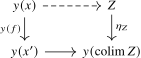 admits a dashed arrow making the square commute. Here \(\eta _Z\) is the unit of the adjunction \(\colim \dashv y\) of Construction A.21, and a
map \(y(x') \to y(\colim Z)\) is the same as a map \(x' \to \colim Z\), since \(y\) is fully faithful.
A compact morphism in the sense of Definition 3.3 is weakly compact: the factorization of \(f^*\) through \(\Map _{\Ind (C)}(y(x),-)\) provides, in particular, a lift of each point. In the terminology of [Krause et al. (2024), Definition 2.2.4], compact morphisms in our sense are called strongly compact.
- (1)
-
If \(x\) is compact, then \(\id _x\) is weakly compact. The converse holds for stable \(C\), see Corollary 4.12 below.
- (2)
-
As in Remark 3.4, weakly compact morphisms form a two-sided ideal: if \(f\colon x \to x'\) is weakly compact and \(k\colon w \to x\), \(h\colon x' \to x''\) are arbitrary, then for every \(g\colon x'' \to \colim _i z_i\) the composite \((gh)f\) factors through some \(z_i\), and hence so does \(ghfk\).
- (3)
-
In particular, every morphism which factors through a compact object is weakly compact.
Proposition 4.4 ([Efimov (2024), Proposition 2.39], [Krause et al. (2024), Proposition 2.4.1]). Let \(C\) be compactly assembled and let \(f\colon x \to x'\) be a morphism in \(C\). Then the following are equivalent:
- (1)
-
\(f\) is compact (in the sense of Definition 3.3);
- (2)
-
\(f\) is weakly compact;
- (3)
-
\(y(f)\colon y(x) \to y(x')\) factors through \(\varepsilon _{x'}\colon \hat {y}(x') \to y(x')\);
- (4)
-
\(\hat {y}(f)\colon \hat {y}(x) \to \hat {y}(x')\) factors through \(\varepsilon _x\colon \hat {y}(x) \to y(x)\);
- (5)
-
\(\hat {y}(f)\) is a weakly compact morphism in \(\Ind (C)\).
Proof.
We use repeatedly that maps \(\hat {y}(w) \to Z\) in \(\Ind (C)\) correspond, under the adjunction \(\hat {y} \dashv \colim \), to maps \(w \to \colim Z\); in particular, two maps \(\hat {y}(w) \to Z\) are homotopic as soon as their images under \(\colim \) are, where we identify \(\colim \hat {y}(w) \simeq w\). Similarly, two maps \(y(w) \to y(w')\) are homotopic as soon as their images under \(\colim \) are, since \(y\) is fully faithful. Recall also that \(\colim (\varepsilon _w) \simeq \id _w\).
(1) \(\iff \) (3) is Lemma 3.5(1), and (1) \(\implies \) (2) was observed in Remark 4.2.
(2) \(\implies \) (3): Write \(\hat {y}(x') \simeq \quotcolim _i z_i\). Then \(\colim _i z_i \simeq \colim \hat {y}(x') \simeq x'\). Applying weak compactness to the identity \(x' \to \colim _i z_i\), we find a map \(h\colon x \to z_i\) for some \(i\) such that the composite \(x \to z_i \to \colim _i z_i \simeq x'\) is homotopic to \(f\). Let \(g\colon y(x) \to \hat {y}(x')\) be the composite of \(y(h)\) with the canonical map \(y(z_i) \to \quotcolim _i z_i\). Then \(\colim (\varepsilon _{x'} g) \simeq \colim (g) \simeq f\), and hence \(\varepsilon _{x'}g \simeq y(f)\).
(3) \(\implies \) (4): Let \(g\colon y(x) \to \hat {y}(x')\) with \(\varepsilon _{x'}g \simeq y(f)\). Then \(g\varepsilon _x\) and \(\hat {y}(f)\) are maps \(\hat {y}(x) \to \hat {y}(x')\) with \(\colim (g\varepsilon _x) \simeq \colim (g) \simeq f \simeq \colim (\hat {y}(f))\), so \(\hat {y}(f) \simeq g\varepsilon _x\).
(4) \(\implies \) (5): The object \(y(x)\) is compact in \(\Ind (C)\), so this follows from Example 4.3(3).
(5) \(\implies \) (2): Let \(g\colon x' \to \colim _i z_i\) be a map in \(C\), and let \(Z = \quotcolim _i z_i = \colim _i y(z_i)\). By adjunction, \(g\) corresponds to a map \(\tilde {g}\colon \hat {y}(x') \to Z\) with \(\colim (\tilde {g}) \simeq g\). By (5), the composite \(\tilde {g}\hat {y}(f)\colon \hat {y}(x) \to \colim _i y(z_i)\) factors through some \(y(z_i)\), say as \(\hat {y}(x) \xrightarrow {u} y(z_i) \to Z\). Applying \(\colim \), we find that \(gf \simeq \colim (\tilde {g}\hat {y}(f))\) factors as \(x \xrightarrow {\colim (u)} z_i \to \colim _i z_i\). □
Remark 4.5. In (5), weak compactness in \(\Ind (C)\) may be replaced by weak compactness in \(\Ind (C^{\kappa })\), for any \(\kappa \) such that \(\hat {y}\) takes values in \(\Ind (C^{\kappa })\), by the same argument. In particular, if \(C\) is dualizable we may take \(\kappa = \omega _1\) (Theorem 3.20), and then \(\Ind (C^{\omega _1})\) is compactly generated.
From now on we simply speak of compact morphisms in compactly assembled categories, and use the characterizations of Proposition 4.4 freely. The following observation is fundamental; it says that compact morphisms can be “interpolated”.
Corollary 4.6 ([Efimov (2024), Corollary 2.40], [Krause et al. (2024), Proposition 2.4.4]). Let \(C\) be compactly assembled. Then every compact morphism \(f\colon x \to x'\) factors as a composite \(x \xrightarrow {f_1} w \xrightarrow {f_2} x'\) of two compact morphisms.
Proof.
By Proposition 4.4, there is \(g\colon y(x) \to \hat {y}(x')\) with \(\varepsilon _{x'}g \simeq y(f)\). Write \(\hat {y}(x') \simeq \quotcolim _i w_i\), so that \(x' \simeq \colim _i w_i\). Since \(\hat {y}\) preserves colimits, also \(\hat {y}(x') \simeq \colim _i \hat {y}(w_i)\) in \(\Ind (C)\). As \(y(x)\) is compact in \(\Ind (C)\), the map \(g\) factors as \[ y(x) \xrightarrow {h} \hat {y}(w_i) \xrightarrow {\hat {y}(f_2)} \hat {y}(x') \] for some \(i\), where \(f_2\colon w_i \to x'\) is the canonical map. Put \(w := w_i\) and \(f_1 := \colim (h)\colon x \to w\). Then \(\varepsilon _w h\) and \(y(f_1)\) have the same image under \(\colim \), so \(\varepsilon _w h \simeq y(f_1)\), and \(f_1\) is compact by Proposition 4.4(3). The map \(y(w) \to \quotcolim _j w_j = \hat {y}(x')\) is a lift of \(y(f_2)\) along \(\varepsilon _{x'}\), since both become \(f_2\) after applying \(\colim \); so \(f_2\) is compact as well. Finally, \(f \simeq \colim (g) \simeq \colim (\hat {y}(f_2))\colim (h) \simeq f_2f_1\). □
By iterating Corollary 4.6, a single compact morphism can be “interpolated” by a dense family of compact morphisms. Since this is also needed for other classes of morphisms (for instance trace-class morphisms, see Proposition 6.19), we formulate it abstractly. We write \(\Q _{[0,1]} = \Q \cap [0,1]\) and \(\Q _{\geq 0} = \Q \cap [0,\infty )\), regarded as partially ordered sets.
Lemma 4.7. Let \(D\) be a category, let \(S\) be a class of morphisms of \(D\) which is closed under homotopy and composition, and let \(P\) be a class of objects of \(D\). Assume that every morphism in \(S\) is homotopic to a composite \(x \to p \to x'\) of two morphisms in \(S\) with \(p \in P\).
- (1)
-
For every morphism \(s\colon x \to x'\) in \(S\) there is a functor \(F\colon \Q _{[0,1]} \to D\) with \(F(0) = x\), \(F(1) = x'\) and \(F(0 \leq 1) \simeq s\), such that \(F(a \leq b) \in S\) for all \(a < b\) and \(F(a) \in P\) for all \(0 < a < 1\).
- (2)
-
For every sequence \(x_0 \to x_1 \to x_2 \to \cdots \) of morphisms in \(S\) there is a functor \(F\colon \Q _{\geq 0} \to D\) whose restriction to \(\N \subseteq \Q _{\geq 0}\) is equivalent to the given sequence, such that \(F(a \leq b) \in S\) for all \(a < b\) and \(F(a) \in P\) for all \(a \notin \N \). If \(D\) admits sequential colimits, then \(\colim _{\Q _{\geq 0}} F \simeq \colim _n x_n\).
Proof.
(1) The set \(T\) of dyadic rationals in \([0,1]\) is a countable dense totally ordered set with a smallest and a largest element, so it is order-isomorphic to \(\Q _{[0,1]}\) by Cantor’s back-and-forth argument; we may therefore replace \(\Q _{[0,1]}\) by \(T\), with \(0\) and \(1\) preserved. Let \(T_k = \{i/2^k \mid 0 \leq i \leq 2^k\}\), so that \(T = \bigcup _k T_k\) and hence \(N(T) = \bigcup _k N(T_k)\). Thus \(\Fun (T,D) \simeq \lim _k \Fun (T_k,D)\), and on cores this is a limit of a tower of animae. So it suffices to construct functors \(F_k\colon T_k \to D\), with \(F_k(a \leq b) \in S\) for \(a < b\) and \(F_k(a) \in P\) for \(0 < a < 1\), together with equivalences \(F_{k+1}|_{T_k} \simeq F_k\). Indeed, a point of the limit of a tower of animae is specified by points at each stage and paths between their successive images; no separate higher compatibility choices are required. As in Remark A.10, a functor out of a finite totally ordered set amounts to a composable sequence of morphisms, and two such functors are equivalent as soon as they agree on objects and their consecutive morphisms are homotopic. Let \(F_0\) be given by \(s\). Given \(F_k\), factor each morphism \(F_k(a \leq a')\) between consecutive elements \(a < a'\) of \(T_k\) as a composite of two morphisms in \(S\) through an object of \(P\), and let \(F_{k+1}\) be the resulting functor on \(T_{k+1}\). Then \(F_{k+1}|_{T_k}\) and \(F_k\) agree on objects, and their consecutive morphisms are homotopic, so \(F_{k+1}|_{T_k} \simeq F_k\). Since \(S\) is closed under composition, every \(F_{k+1}(a \leq b)\) with \(a < b\) is in \(S\).
(2) Apply the construction of (1) simultaneously to all morphisms \(x_n \to x_{n+1}\): on the dyadic rationals in \([0,\infty )\), which are the union of the subsets \(2^{-k}\N \), we refine the given sequence on \(\N = 2^{0}\N \) by factoring consecutive morphisms as before. The set of dyadic rationals in \([0,\infty )\) is order-isomorphic to \(\Q _{\geq 0}\) by an isomorphism fixing \(\N \) (apply the back-and-forth argument to each interval \([n,n+1]\)). Finally, \(\N \subseteq \Q _{\geq 0}\) is cofinal, so the colimits agree by Lemma A.7. □
Proposition 4.8 ([Krause et al. (2024), Propositions 2.4.4 and 2.4.6]). Let \(C\) be compactly assembled.
- (1)
-
Every compact morphism \(f\colon x \to x'\) factors as \(x \to w \to x'\) with both morphisms compact and \(w\) an \(\omega _1\)-compact object.
- (2)
-
Every compact morphism \(f\colon x \to x'\) extends to a functor \(F\colon \Q _{[0,1]} \to C\) with \(F(0 \leq 1) \simeq f\), such that \(F(a \leq b)\) is compact for all \(a < b\) and \(F(a)\) is \(\omega _1\)-compact for \(0 < a < 1\).
- (3)
-
An object of \(C\) is \(\omega _1\)-compact if and only if it is the colimit of a functor \(F\colon \Q _{\geq 0} \to C\), or equivalently of a functor \(F\colon \Q \to C\), such that \(F(a \leq b)\) is compact for all \(a < b\). Moreover, \(F\) can be chosen to take values in \(\omega _1\)-compact objects.
Proof.
(1) By Corollary 4.6, applied twice, \(f\) factors as \(x \to x_0 \to x_0' \to x'\) with all three maps compact. By Theorem 3.20(1), \(x_0'\) is a filtered colimit of \(\omega _1\)-compact objects, so the compact (hence weakly compact, by Proposition 4.4) morphism \(x_0 \to x_0'\) factors as \(x_0 \to w \to x_0'\) with \(w\) \(\omega _1\)-compact. Since compact morphisms form an ideal, \(x \to x_0 \to w\) and \(w \to x_0' \to x'\) are compact.
(2) Apply Lemma 4.7(1) to the class \(S\) of compact morphisms and the class \(P\) of \(\omega _1\)-compact objects, using (1).
(3) By Theorem 3.20(2), Remark 3.21 and Proposition 4.4, an object \(x\) is \(\omega _1\)-compact if and only if \(x \simeq \colim _n x_n\) for a sequence of compact morphisms \(x_n \to x_{n+1}\). By (1), each \(x_n \to x_{n+1}\) factors as \(x_n \to w_n \to x_{n+1}\) through an \(\omega _1\)-compact \(w_n\), with both maps compact. The sequence \(w_0 \to w_1 \to \cdots \) of composites \(w_n \to x_{n+1} \to w_{n+1}\) again consists of compact morphisms between \(\omega _1\)-compact objects, and has colimit \(x\) by cofinality. Applying Lemma 4.7(2) to it (with \(P\) the \(\omega _1\)-compact objects) gives a functor \(F\colon \Q _{\geq 0} \to C\) with the required properties and colimit \(x\). Since \(\Q _{> 0} \subseteq \Q _{\geq 0}\) is cofinal and \(\Q _{> 0}\) is order-isomorphic to \(\Q \) (both are countable dense totally ordered sets without endpoints), we may equivalently use \(\Q \). Conversely, the colimit of such a functor is the colimit of its restriction to the cofinal subset \(\N \), which is \(\omega _1\)-compact by Theorem 3.20(2). □
For stable categories there is a useful reformulation of compactness, which only involves ind-objects with vanishing colimit. This is the definition of compact morphisms used by Clausen and Mathew.
Proposition 4.9. Let \(C\) be a stable category with filtered colimits (e.g. \(C \in \PrL _{\st }\)), and let \(f\colon x \to x'\) be a morphism in \(C\). Then \(f\) is weakly compact if and only if for every \(Z \in \Ind (C)\) with \(\colim Z \simeq 0\), the map \[ f^*\colon \pi _0\Map _{\Ind (C)}(y(x'),Z) \to \pi _0\Map _{\Ind (C)}(y(x),Z) \] is zero. Explicitly, this means: for every filtered diagram \((z_i)_{i \in I}\) with \(\colim _i z_i \simeq 0\) and every map \(g\colon x' \to z_i\), there is \(i' \geq i\) such that the composite \(x \xrightarrow {f} x' \xrightarrow {g} z_i \to z_{i'}\) is nullhomotopic.
Proof.
Note that \(\Ind (C)\) is stable, and that filtered colimits in \(C\) as well as the colimit functor \(\Ind (C) \to C\) are exact.
Suppose that \(f\) is weakly compact, and let \(Z = \quotcolim _{i \in I} z_i\) with \(\colim _i z_i \simeq 0\); by Theorem A.8 we may assume that \(I\) is a filtered partially ordered set. A map \(y(x') \to Z\) is represented by some \(g\colon x' \to z_{i_0}\). For \(i \geq i_0\) write \(g_i\colon x' \to z_i\) for the composite with the transition map, and \(w_i := \fib (g_i)\). As \(\{i \geq i_0\} \subseteq I\) is cofinal and filtered colimits are exact, the canonical map \[ \colim _{i \geq i_0} w_i \to \fib \big (x' \to \colim _{i \geq i_0} z_i\big ) \simeq x' \] is an equivalence. Applying weak compactness of \(f\) to the inverse of this equivalence, we find \(i \geq i_0\) and a map \(b\colon x \to w_i\) such that \(f\) is homotopic to the composite of \(b\) with \(w_i \to x'\). Hence \(g_if\) factors through \(g_i \circ (w_i \to x') \simeq 0\), so \(g_if \simeq 0\), and the image of our map under \(f^*\) vanishes.
Conversely, suppose the condition holds, and let \(g\colon x' \to \colim _i z_i\). Put \(Z = \quotcolim _i z_i\), let \(\eta _Z\colon Z \to y(\colim Z)\) be the unit of \(\colim \dashv y\), and let \(W = \cofib (\eta _Z)\). Then \(\colim W \simeq \cofib (\colim (\eta _Z)) \simeq 0\), since \(\colim (\eta _Z)\) is an equivalence. In the exact sequence of abelian groups \[ \pi _0\Map (y(x),Z) \xrightarrow {(\eta _Z)_*} \pi _0\Map (y(x),y(\colim Z)) \to \pi _0\Map (y(x),W), \] the class of \(y(gf) = y(g)y(f)\) maps to the image under \(f^*\) of the class of the composite \(y(x') \xrightarrow {y(g)} y(\colim Z) \to W\), which vanishes by assumption. Hence \(y(gf) \simeq \eta _Z\psi \) for some \(\psi \colon y(x) \to Z\). Since \(y(x)\) is compact, \(\psi \) is represented by a map \(\psi _0\colon x \to z_i\) for some \(i\), and \(\eta _Z\psi \) is then \(y\) of the composite \(x \xrightarrow {\psi _0} z_i \to \colim _i z_i\). As \(y\) is fully faithful, \(gf\) is homotopic to this composite. □
Remark 4.10. In the literature one also finds weaker, “elementwise” definitions of compact morphisms. For instance, Clausen and Mathew call a morphism \(f\colon x \to x'\) in a presentable stable category compact if for every filtered diagram \((z_j)_j\) with \(\colim _j z_j \simeq 0\), every map \(x' \to z_j\) becomes nullhomotopic after precomposition with \(f\) and postcomposition with \(z_j \to z_{j'}\) for some \(j' \geq j\). In compactly assembled categories this agrees with Definition 3.3, by Proposition 4.4, Proposition 4.9.
Remark 4.11. The vanishing-colimit test in Proposition 4.9 characterizes weak compactness in any stable category with filtered colimits. Compact assembly is used only to identify this with the natural factorization condition of Definition 3.3, via Proposition 4.4.
Corollary 4.12 (cf. [Efimov (2024), Remark 2.38]). Let \(C\) be a stable category with filtered colimits. Then \(x \in C\) is compact if and only if \(\id _x\) is weakly compact.
Proof.
Suppose that \(\id _x\) is weakly compact. By Proposition 4.9, we have \(\pi _0\Map _{\Ind (C)}(y(x),W) = 0\) for every \(W \in \Ind (C)\) with \(\colim W \simeq 0\). Applying this to all shifts of \(W\), we get \(\hom _{\Ind (C)}(y(x),W) \simeq 0\). For \(Z = \quotcolim _i z_i\), applying this to the fiber \(W\) of the unit \(\eta _Z\colon Z \to y(\colim Z)\) shows that \begin {align*} \colim _i \hom _C(x,z_i) &\simeq \hom _{\Ind (C)}(y(x),Z) \\ &\to \hom _{\Ind (C)}(y(x),y(\colim Z)) \simeq \hom _C(x,\colim _i z_i) \end {align*}
is an equivalence, i.e. \(x\) is compact. The converse is Example 4.3(1). □