Let us now see Efimov’s theory in action, and in particular come back to the two problems raised in Section 1.2.
Sheaves on locally compact Hausdorff spaces
The first computation shows that continuous K-theory is a genuinely new invariant: the category \(\Shv (\R ^n;\Sp )\), for \(n \geq 1\), has no nonzero compact objects, so the only K-theory one could have assigned to it naively is zero.
Theorem 1.12 (Efimov, [Efimov (2024), Theorem 10.10]). Let \(C\) be dualizable and \(X\) a locally compact Hausdorff space. Then \[ K^{\cont }(\Shv (X;C)) \simeq \Gamma _c(X;K^{\cont }(C)). \]
Orientation for the proof. Closed excision for sheaves and continuity under inverse limits of compact Hausdorff spaces are important inputs. Continuity here means that the contravariant invariant sends a cofiltered limit of spaces to a filtered colimit of spectra. Identifying the resulting invariant with compactly supported cohomology requires an additional argument, supplied in [Efimov (2024), Section 10, especially Theorem 10.10]. We do not reproduce that proof here.
Example 1.13. Taking \(X = \R ^n\), we get \(K^{\cont }(\Shv (\R ^n;C)) \simeq \Omega ^n K^{\cont }(C)\). In particular, the higher K-groups of \(C\) can be recovered as Grothendieck groups: \[ K^{\cont }_n(C) \cong K^{\cont }_0(\Shv (\R ^n;C)). \]
Idempotent algebras and the compact operators
A large supply of dualizable categories comes from idempotent maps of ring spectra \(A \to B\), i.e. maps for which \(B \otimes _A B \to B\) is an equivalence. Equivalently, the base change functor \(- \otimes _A B\colon \D (A) \to \D (B)\) is a localization (a homological epimorphism, see Definition 2.16). Its kernel \[ \D (A \to B) := \ker \big (\D (A) \to \D (B)\big ) \] is then dualizable by Theorem 1.2(1), and \[ K^{\cont }(\D (A \to B)) \simeq \fib \big (K(A) \to K(B)\big ). \] In fact, every dualizable category is of this form (Proposition 5.2): the Calkin sequence above exhibits \(C\) as the kernel of \(\Ind (C^{\kappa }) \to \Ind (\Calk ^{\cont }_{\kappa }(C))\), and for \(\kappa \) large enough one can replace \(C^{\kappa }\) by a subcategory with a single generator.
Example 1.14. By a theorem of Wodzicki, if \(A\) is a unital C\(^*\)-algebra and \(I \subseteq A\) a closed two-sided ideal, then \(A \to A/I\) is idempotent. Applying this to \(A = B(\Hh )\) and \(I = \Kk \), we get a dualizable category \(\D (\Kk ) := \D (B(\Hh ) \to B(\Hh )/\Kk )\), and \[ K^{\cont }(\D (\Kk )) \simeq \fib \big (K(B(\Hh )) \to K(B(\Hh )/\Kk )\big ) = K(\Kk ) \simeq \KU . \] So this is the category we were looking for in Section 1.2! Since \(K(B(\Hh )) = 0\) by an Eilenberg swindle, \(K^{\cont }(\D (\Kk ))\) is the loop spectrum of the K-theory of the Calkin algebra \(B(\Hh )/\Kk \); this is the origin of the name “Calkin category”.
According to Clausen [Clausen (2023a)], there is an intrinsic model of \(\D (\Kk )\) using sequential colimits of separable complex Hilbert spaces along compact operators. The construction and its exact-category conventions are given in Proposition 5.13, which also proves that the completed Hilbert tensor product makes this model a commutative algebra in \(\Pr ^{\dual }\). The lecture interprets the resulting multiplicative structure on continuous K-theory through this model.
Nuclear modules and K-theory of analytic spaces
For a commutative ring \(R\) with a finitely generated ideal \(I\), the category \(\Nuc ^{CS}(R^{\wedge }_I)\) of nuclear modules in the sense of Clausen–Scholze provides an input for continuous K-theory of the formal completion. Here \(R^{\wedge }_I\) denotes derived completion. An operator-algebra presentation analogous to the compact-operator example is given in Example 6.21. The category \(\Nuc ^{CS}(R^{\wedge }_I)\) can be obtained from the category of solid \(R^{\wedge }_I\)-modules by a “rigidification” procedure, see Section 6.2. Efimov also introduced a variant \(\Nuc (R^{\wedge }_I)\), which contains \(\Nuc ^{CS}(R^{\wedge }_I)\) as a full subcategory with the same compact objects [Efimov (2025), Corollary 7.6]. The comparison induces an isomorphism on continuous K-theory [Efimov (2025), Corollary 7.11]. We keep the notation \(\Nuc ^{CS}\) for the Clausen–Scholze category and \(\Nuc \) for Efimov’s variant; equality of compact objects alone would not imply this K-theoretic comparison. Efimov computed the continuous K-theory:
Theorem 1.15 (Efimov, [Efimov (2025), Corollary 6.3]). Let \(R\) be a commutative ring, and \(I = (f_1, \dots , f_m) \subseteq R\). Then \[ K^{\cont }(\Nuc (R^{\wedge }_I)) = \lim _{n \to \infty } K(R \quot (f_1^n, \dots ,f^n_m)). \]
The same formula holds for \(\Nuc ^{CS}(R^{\wedge }_I)\) [Efimov (2025), Corollary 7.10], and if \(R\) is Noetherian, the right-hand side is \(\lim _n K(R/I^n)\).
The Clausen–Scholze construction also applies to complete analytic Huber pairs. Rational localizations then have the categorical localization properties needed for descent. In the following theorem, \(\Nuc \) denotes the nuclear category associated with the analytic ring of the Huber pair, as in Andreychev, not an identification with Efimov’s variant for formal completions. The descent theorem is an additional result; it does not follow just from the calculation for formal completions.
Theorem 1.16 (Andreychev, [Andreychev (2023), Satz 4.2 and Satz 5.12]). Let \((A,A^+)\) be a complete sheafy analytic Huber pair. The assignments \(U \mapsto \Nuc (\mathcal {O}(U))\) and \(U \mapsto K^{\cont }(\Nuc (\mathcal {O}(U)))\), for \(U \subseteq \operatorname {Spa}(A,A^+)\) rational open, satisfy descent for covers by rational open subsets.
A related result is the pro-descent theorem of Kerz–Strunk–Tamme [Kerz et al. (2018), Theorem A]. One consequence, after
taking inverse limits, is the following: if \(f\colon X \to Y\) is a proper map of Noetherian schemes which is an
isomorphism outside a closed subscheme \(Z \subseteq Y\), then the square 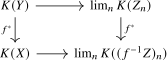 is a pullback, where \(Z_n\) and \((f^{-1}Z)_n\) denote
the \(n\)-th infinitesimal thickenings. The pro-descent theorem is stronger than this inverse-limit
statement. The nuclear-module viewpoint suggests interpreting the right-hand terms through
formal completions and comparing their punctured generic fibers. This is motivation, not a proof
here: it requires localization and formal-gluing results beyond the rational descent theorem
above.
Outlook: archimedean analytic geometry
The same ideas apply in archimedean functional analysis. There is a canonical rigid category \(\D ^{\mathrm {an}}(\C )\) (obtained for instance by rigidifying the category of liquid \(\C \)-modules, independently of the choice of \(p\)), and Clausen–Scholze have announced results relating the continuous K-theory of complex analytic spaces built from it to topological K-theory and to (Hodge-filtered) de Rham cohomology. We will not discuss this further in these notes.