Proposition 19.4.8 ([Barkan et al. (2022), Corollary 5.1.15]). The restriction functor \(\Op _{\infty } \to \Op _{\infty }^{\mathrm {Lurie}}\) is an equivalence.
Proof. By Lemma 19.4.4, we may work with \(\Ff _{\mathrm {Lurie}}\)-\(\infty \)-operads. The envelope of the terminal such \(\infty \)-operad is \((\Fin ,\amalg )\), by the same calculation as in Lemma 19.3.15. Thus Lemma 19.2.9, followed by the Segal equivalence of Proposition 5.3.9, gives a fully faithful functor \[ \Env ^{\mathrm {Lurie}}\colon \Op _\infty ^{\mathrm {Lurie}} \longrightarrow (\Cat _\infty ^\otimes )_{/(\Fin ,\amalg )}. \] In these envelopes, objects are again tuples of colors, with tensor product given by concatenation, as in Lemma 19.3.13. The Segal condition therefore gives condition (1) of Proposition 19.3.19. The hom-anima calculation of Lemma 19.3.14 also applies, using condition (2) of Definition 19.4.3 over forward maps, and gives condition (2) of that proposition. Hence the essential image of \(\Env ^{\mathrm {Lurie}}\) is contained in that of \(\Env \).
Conversely, let \(u\colon \Fin _* \hookrightarrow \Span (\Fin )\) be the inclusion and let \(\Oo \) be an \(\infty \)-operad over \(\Span (\Fin )\). Applying Lemma 19.4.7 to \(p_{\Oo }\) identifies the cocartesian fibration defining \(\Env ^{\mathrm {Lurie}}(u^*\Oo )\) with the restriction of the one defining \(\Env (\Oo )\). Under the Segal equivalence, this gives a natural symmetric monoidal equivalence \[ \Env ^{\mathrm {Lurie}}(u^*\Oo ) \simeq \Env (\Oo ). \] It is compatible with the maps to \((\Fin ,\amalg )\) by naturality, so the two envelope functors have the same essential image. We obtain a naturally commutative diagram
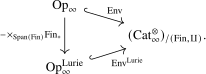
Both diagonal functors are equivalences onto the same essential image. It follows by 2-out-of-3 that the left vertical functor is an equivalence, as desired. □