Proposition 19.3.19 ([Barkan et al. (2022), Example 4.3.1 and Observation 4.3.2]). The induced functor \[ \Env \colon \Op _{\infty } \to (\Cat _{\infty }^{\otimes })_{/(\Fin ,\amalg )} \] is fully faithful. A symmetric monoidal functor \(p\colon C \to (\Fin ,\amalg )\) lies in the essential image if and only if it satisfies the following two conditions:
- (1)
-
For every finite set \(I\), the tensor product in \(C\) defines an equivalence \[ \prod _{i \in I} C_{\{i\}} \iso C_I, \] where \(C_I\) is the fiber of \(p\) over \(I \in \Fin \);
- (2)
-
For every finite collection \((I_j)_{j \in J}\) of finite sets and objects \(X_j \in C_{I_j}\) and \(y_j \in C_{\{j\}}\), the commutative square
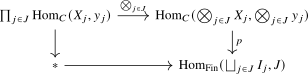
is a pullback square, where the bottom map selects the function \(\bigsqcup _{j \in J} I_j\to J\) whose restriction to \(I_j\) has value \(j\).
Proof. Under straightening, full faithfulness follows from Lemma 19.2.9. For \(C=\Env (\Oo )\), condition (1) follows from the Segal condition on \(\Oo \) and Lemma 19.3.13. Condition (2) follows by taking the fiber in Lemma 19.3.14 over the function \(\bigsqcup _j I_j\to J\) with value \(j\) on \(I_j\).
Conversely, suppose that \(p\colon C\to (\Fin ,\amalg )\) satisfies (1) and (2). Let \(\Oo \subseteq \Mm _C\) be the full suboperad on objects whose image under \(p\) is a singleton, as in Construction 14.1.7. The unit \(\Comm \to \Mm _{(\Fin ,\amalg )}\) identifies \(\Comm \) with the full suboperad on the singleton: its multimorphism animae are the singleton sets \(\Hom _{\Fin }(I,\lra {1})\). Thus the morphism of \(\infty \)-operads \(\Mm _p\colon \Mm _C\to \Mm _{(\Fin ,\amalg )}\) induced by \(p\) factors through this unit after restriction to \(\Oo \). By naturality of the adjunction \(\Env \dashv \Mm \), the symmetric monoidal functor \(\Env (\Oo )\to C\) adjoint to the inclusion \(\Oo \hookrightarrow \Mm _C\) is therefore a functor over \((\Fin ,\amalg )\).
The colors of \(\Oo \) identify with the objects of \(C_{\lra {1}}\), so condition (1) makes this functor essentially surjective. Since \(\Oo \) is a full suboperad of \(\Mm _C\), we have \(\Oo (\{x_i\};y)\simeq \Hom _C(\bigotimes _i x_i,y)\). Consequently, Lemma 19.3.14 identifies the fiber over \(f\colon I\to J\) of the hom anima from \(\{x_i\}_{i\in I}\) to \(\{y_j\}_{j\in J}\) in \(\Env (\Oo )\) with \[ \prod _{j\in J} \Hom _C\left (\bigotimes _{i\in f^{-1}(j)}x_i,y_j\right ). \] The map induced by \(\Env (\Oo )\to C\) on this fiber tensors the displayed morphisms. By condition (2), it is an isomorphism onto the fiber over \(f\) of \[ \Hom _C\left (\bigotimes _{i\in I}x_i,\bigotimes _{j\in J}y_j\right ) \longrightarrow \Hom _{\Fin }(I,J). \] Taking the coproduct over all \(f\) proves full faithfulness. □