Lemma 1.7.13. The functor \(\pushout \times [1] \to [1] \times [1]\) described informally by the diagram
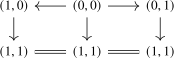
induces an equivalence \(\pushout ^{\triangleright } \iso [1] \times [1]\).
Proof. Since \(\pushout \! \times [1]\) is a pushout of two copies of \([1] \times [1]\) and \([1] \times [1]\) is a pushout of two copies of \([2]\), we may construct such a functor by gluing two copies of the functor \(p_2\colon [1] \times [1] \to [2]\) from Construction 1.4.3. By construction, the restriction of this functor to \(\pushout \! \times \{1\}\) is the identity on \((1,1)\), hence it factors through a map \(\pushout ^{\triangleright } \to [1] \times [1]\). To show that it is an equivalence, we must show that for any \(\infty \)-category \(C\) the induced commutative square
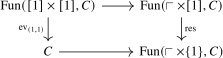
is a pullback square. Again using the pushout descriptions of \(\pushout \! \times [1]\), \([1] \times [1]\) and \(\pushout \! \times \{1\}\), this square may be identified with

The claim now follows from the right pullback square in Proposition 1.4.4. □