A symmetric monoidal \(\infty \)-category whose tensor product distributes over finite coproducts has two compatible operations: addition by coproduct and multiplication by tensor product. We show that these operations define a coherent commutative semiring object in \(\Cat _{\infty }\). To do so, we use the tensor product \(\otimes _{\mathrm {coprod}}\) from Example 18.1.2, which represents functors preserving finite coproducts separately in each variable.
Lemma 20.3.1. The \(\infty \)-category \(\Cat _{\infty }^{\mathrm {coprod}}\) is presentable and semiadditive. Its zero object is the terminal \(\infty \)-category, and the cartesian product \(C\times D\) is also the coproduct of \(C\) and \(D\). Moreover, the tensor product \(\otimes _{\mathrm {coprod}}\) makes \(\Cat _{\infty }^{\mathrm {coprod}}\) presentably symmetric monoidal.
Proof. Presentability is the finite-coproduct case of [Lurie (2017), Lemma 4.8.4.2]. Finite products are computed in \(\Cat _{\infty }\) and therefore given by cartesian products of \(\infty \)-categories. The terminal \(\infty \)-category is also initial in \(\Cat _{\infty }^{\mathrm {coprod}}\), since a finite-coproduct-preserving functor from it to \(C\) must select an initial object of \(C\).
Let \(0_C\) and \(0_D\) denote initial objects. For every \(E\in \Cat _{\infty }^{\mathrm {coprod}}\), restriction along \(c\mapsto (c,0_D)\) and \(d\mapsto (0_C,d)\) induces an equivalence \[ \Fun ^{\amalg }(C\times D,E) \iso \Fun ^{\amalg }(C,E)\times \Fun ^{\amalg }(D,E). \] An inverse sends \((F,G)\) to the functor \((c,d)\mapsto F(c)\amalg G(d)\). This preserves finite coproducts because the coproduct functor \(E\times E\to E\) is left adjoint to the diagonal. The two composites are naturally isomorphic to the identity, using \((c,d)\simeq (c,0_D)\amalg (0_C,d)\) and preservation of initial objects. Thus \(C\times D\) is also a coproduct in \(\Cat _{\infty }^{\mathrm {coprod}}\), proving semiadditivity.
Finally, the universal property of \(\otimes _{\mathrm {coprod}}\) gives a right adjoint \(\Fun ^{\amalg }(D,-)\) to \(-\otimes _{\mathrm {coprod}}D\), with finite coproducts in this functor category computed pointwise. Hence tensoring preserves colimits, proving the final assertion. □
Proposition 20.3.2 (Cocartesian semiring construction). The functor \[ \Cat _{\infty }^{\mathrm {coprod}}\longrightarrow \CMon (\Cat _{\infty }), \qquad C\longmapsto (C,\amalg ), \] has a canonical lax symmetric monoidal refinement, where the source carries \(\otimes _{\mathrm {coprod}}\) and the target carries the symmetric monoidal structure of Proposition 16.4.1.
Proof. The forgetful functor \(U\colon \Cat _{\infty }^{\mathrm {coprod}}\to \Cat _{\infty }\) is canonically lax symmetric monoidal: by Example 18.1.2, the multimorphisms in the source are functors preserving finite coproducts separately in each variable, and their inclusion into all functors is an operad map.
By Lemma 20.3.1, the multimorphism operad of \(\Cat _{\infty }^{\mathrm {coprod}}\) is semiadditive. Moreover, \(U\) preserves finite products, since they are computed by cartesian products of \(\infty \)-categories on both sides. The adjunction of Theorem 20.2.10 therefore gives a unique lift
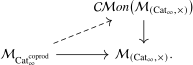
The upper-right \(\infty \)-operad is \(\Mm _{\CMon (\Cat _{\infty })}\) by Corollary 20.4.5. The lift therefore gives a lax symmetric monoidal functor to \(\CMon (\Cat _{\infty })\). On \(C\), its commutative monoid structure is induced by the biproducts in \(\Cat _{\infty }^{\mathrm {coprod}}\): the unit selects \(0_C\), and addition is the codiagonal \(C\times C\simeq C\oplus C\to C\). By the preceding lemma, this is the coproduct functor \(\amalg \colon C\times C\to C\), as required. □
Applying this functor to commutative algebras gives the following result.
Proposition 20.3.3. Let \(C\) be a small symmetric monoidal \(\infty \)-category with finite coproducts, and assume that its tensor product preserves finite coproducts separately in each variable. Then \(C\) canonically defines an object of \[ \CRig (\Cat _{\infty })=\CAlg (\CMon (\Cat _{\infty })). \] Its addition is the coproduct, with zero the initial object, and its multiplication is the tensor product, with unit \(\unit _C\).
Proof. By Example 18.1.2, the given symmetric monoidal structure makes \(C\) a commutative algebra in \((\Cat _{\infty }^{\mathrm {coprod}},\otimes _{\mathrm {coprod}})\). Applying the lax symmetric monoidal functor of Proposition 20.3.2 produces a commutative algebra in \(\CMon (\Cat _{\infty })\), whose underlying commutative monoid is the cocartesian monoidal structure \((C,\amalg )\). □
Corollary 20.3.4. Under the hypotheses of Proposition 20.3.3, the groupoid core \(C^{\simeq }\) is canonically an object of \(\CRig (\An )\).
Proof. Apply the lax symmetric monoidal groupoid core functor of Proposition 16.4.6 to the commutative algebra supplied by Proposition 20.3.3. □